





The Nearly Invisible Wonder
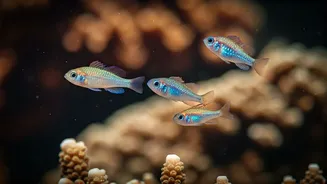
In the murky, acidic peat swamps of Southeast Asia resides a fish that defies easy detection: the Paedocypris progenetica. This minuscule creature rarely
exceeds 8 millimetres in length, its near-transparent body serving as an exceptional camouflage in its challenging environment. Living in waters with limited oxygen and high acidity, it has developed remarkable resilience, reaching full maturity in a mere few weeks. Its survival is a testament to nature's ability to adapt even the most delicate forms to extreme conditions, showcasing how life finds a way in the most unlikely aquatic landscapes.
Reef Drifter's Secret
Off the vibrant coral reefs of northern Australia, a different kind of tiny marvel floats by – the Schindleria brevipinguis. Measuring approximately 8 millimetres, this fish is so small and light it could easily drift unnoticed with the ocean currents. Its primary sustenance comes from plankton, and its delicate form is perfectly suited for a life spent navigating the open water. In an ecosystem teeming with predators, this diminutive species demonstrates that being small and adaptable is a powerful survival tactic, allowing it to thrive in the complex reef environment.
The Miniature Goby
Hailing from the Philippines, the Pandaka pygmaea, commonly known as the dwarf pygmy goby, is another incredible example of extreme miniaturization in fish. This species barely reaches one centimetre in length and prefers to dwell in calm, shallow waters, often seeking refuge among aquatic plants and roots. Its diet consists of microscopic organisms, and its small, agile body is crucial for evading potential threats. This goby is surprisingly sensitive to environmental shifts, highlighting the delicate balance required for its survival and the importance of its specific habitat.
Swamp Dweller's Camouflage
A close relative of Paedocypris progenetica, the Paedocypris micromegethes is another inhabitant of Southeast Asia's dense, murky swamps. This species also measures barely one centimetre, and its translucent body makes it nearly invisible within the water column. It thrives in conditions that are often nutrient-poor and highly acidic, proving that even the smallest organisms can successfully adapt to and flourish in some of the planet's most challenging terrestrial aquatic zones.
Deep Sea's Tiny Partner
The Photocorynus spiniceps inhabits a vastly different realm – the profound darkness of the deep ocean. In this lightless world, the males of this species are remarkably small, reaching only about 6 millimetres. Their survival strategy is unique: they attach themselves to much larger females, becoming entirely dependent on them. Lacking sight in the pitch-black depths, they rely on tactile sensations and chemical cues to navigate their existence. This demonstrates a remarkable evolutionary adaptation where being incredibly small is not a disadvantage but a clever strategy for survival in an extreme environment.