







Automated Herding System
Traditional dairy farming, often starting before dawn with manual labor to gather hundreds of cows, is being revolutionized. A groundbreaking system, valued
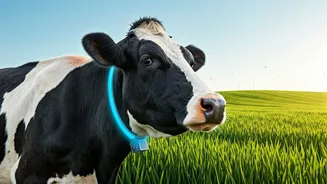
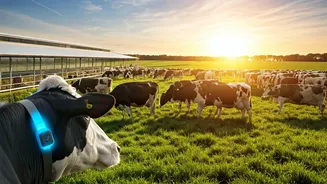
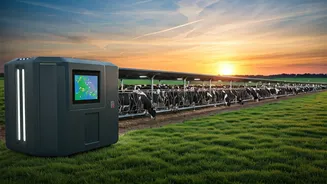
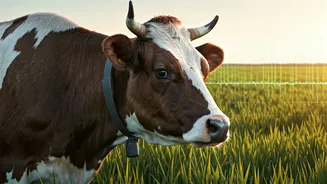
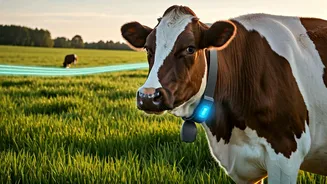
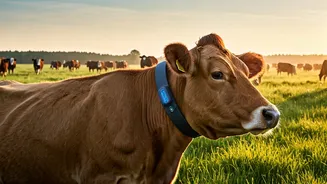
at $2 billion, eliminates the need for dogs, farmhands, and physical fences. Each cow wears a specialized collar that emits a sound, guiding them autonomously to milking stations. This innovation replaces the costly and labor-intensive methods of the past, such as constructing miles of fencing which can cost upwards of $40,000 per mile and require constant upkeep. Beyond mere herding, this technology addresses unaddressed issues like unnoticed health problems and missed fertility windows, fundamentally changing how farms operate by moving away from reliance on human observation and traditional tools.
Virtual Fencing Explained
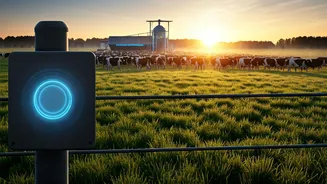
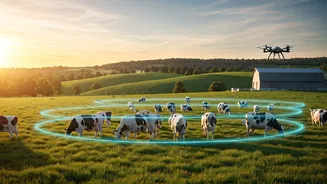
The core of this AI-driven solution lies in its sophisticated virtual fencing capabilities. Farmers utilize a mobile application, similar to using Google Maps, to draw digital boundaries on a satellite view of their land. These boundaries, defined by GPS coordinates, are instantly transmitted to the collars worn by each animal. The collars continuously track the cows' positions multiple times per minute. When a cow approaches the designated virtual boundary, the collar emits an audible cue from one side, signaling the animal to turn away. Through a process of trained association, the cow learns to associate this sound with deviating from the boundary, a cue that stops once they turn. This automated system manages the animals' movement throughout the day without any direct human intervention, ensuring they remain within the designated areas.
Pavlovian Animal Training
The true innovation behind this system isn't just advanced technology, but a deep understanding of behavioral science, reminiscent of Pavlovian conditioning. During an initial week-long onboarding phase, farmers physically guide the herd while the collars provide auditory prompts. This direct guidance reinforces the association between the sound and the desired action: turning away from the boundary. As the cows learn, the need for physical presence diminishes. Within days, the response becomes automatic, and by the end of the week, direct supervision in the paddocks is no longer necessary. Leveraging the natural social behavior of cows, where one animal’s response influences others, the entire herd learns collectively and efficiently, reliably responding to algorithmic commands within days, significantly boosting operational efficiency.
The Cowgorithm's Insight
Beyond guiding movement, the smart collars provide continuous, in-depth monitoring of each individual animal. Data on chewing habits, body temperature, movement patterns, and rest cycles are meticulously collected, creating a unique behavioral profile for every cow. The AI system, dubbed the 'Cowgorithm', is trained on vast datasets from hundreds of thousands of animals over many years, allowing it to recognize normal patterns for each. Deviations from these norms, such as reduced chewing or altered gait, are flagged by the system, often 24 to 48 hours before visible symptoms of illness appear. This early detection capability is crucial for reducing treatment costs and improving animal health outcomes. Furthermore, the system excels at fertility tracking, identifying subtle behavioral changes during a cow's narrow breeding window of 12-18 hours and alerting farmers at the optimal time, thereby enhancing reproductive efficiency across large herds.
Economic Impact and Growth
The adoption of this virtual fencing technology has led to substantial economic benefits. Across the United States alone, users have established over 11,000 miles of virtual fences, a figure comparable to the perimeter of the continental United States, resulting in an estimated $220 million in savings on physical fencing costs. The system is currently managing herds comprising over 700,000 cattle across New Zealand, Australia, and 22 US states. This technology operates on a subscription model, with costs ranging from $5 to $8 per cow per month, and the collars are leased rather than sold. For a farm with 500 cows, this could amount to approximately $3,000 monthly, with larger operations incurring higher fees. Once a farm integrates this digital infrastructure into its operations, transitioning away becomes challenging due to the established reliance.
Peter Thiel's Vision
The significant backing from Peter Thiel's Founders Fund underscores the revolutionary potential of this agricultural technology. The fund has been invested in the company since its early development stages in 2018, demonstrating a long-term commitment. Having witnessed the company's expansion to manage hundreds of thousands of animals, Founders Fund has now led a new funding round, assigning the startup a valuation of approximately $2 billion. This substantial investment reflects a strong belief in the technology's innovative capabilities and its promising future prospects. The valuation signifies a major endorsement of the company's approach to transforming a traditional industry through advanced technological integration.
Beyond the Farm Gate
The implications of this technology extend far beyond the agricultural sector. At its heart, this system has successfully engineered a method for coordinating thousands of living beings in real-time, utilizing data, sensors, and behavioral prompts. While its current application is in farming, the fundamental principles could be adapted for applications in wildlife management, complex logistics operations, and advancements in robotics. This represents a paradigm shift in managing physical environments, where tasks previously demanding constant human intervention can now be guided by sophisticated, continuous background software systems. Furthermore, it addresses critical labor challenges within agriculture, an industry often reliant on physically demanding work and facing a declining workforce, by reducing the need for manual labor while simultaneously boosting overall efficiency and productivity.