


The Slippery Hazard
Every home cook has experienced the unnerving wobble of a cutting board mid-chop, especially when tackling demanding tasks like dicing a mountain of onions
for a curry. While we meticulously choose quality knives and premium ingredients, the instability of our workspace often goes overlooked, presenting a significant, yet easily rectifiable, danger. This common kitchen mishap can lead to accidents, but the most effective solution isn't an expensive gadget; it's a humble, damp kitchen towel. This simple technique, rooted in basic physics, ensures your cutting board remains steadfast, transforming your cooking environment into a safer, more controlled space for all culinary endeavors.
Friction and Stability
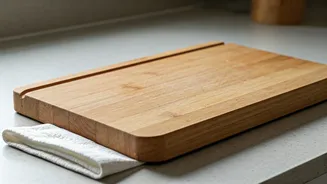
The ingenious effectiveness of a damp towel in securing a cutting board lies in the principles of friction and surface tension. When a dry cutting board, whether wood or plastic, sits on a smooth countertop, the minimal friction allows it to slide easily. However, introducing a slightly moist towel between the board and the surface dramatically increases this friction. Water acts as a binder, creating surface tension that grips both the board and the countertop, effectively anchoring it in place. This enhanced grip is crucial, not only for preventing the board from shifting unexpectedly but also for mitigating issues related to surface texture and porosity, which can affect board stability and longevity. The damp towel ensures a consistent, reliable surface, regardless of the countertop material or board type.
Hygiene and Precision
Beyond mere stability, a firmly secured cutting board is paramount for maintaining kitchen hygiene and ensuring precise movements. When a board is fixed, the risk of food debris falling onto less-sanitary areas of the countertop or the knife accidentally contaminating other ingredients is significantly reduced. This stability directly contributes to preventing cross-contamination, a critical aspect of safe food preparation. Furthermore, the confidence derived from a steady workspace allows for more controlled and efficient chopping, slicing, and dicing. This not only speeds up the cooking process but also elevates the overall professional feel of your kitchen, making every cut more accurate and secure, thus upholding stringent cleanliness standards.
Board Types and Care
The damp towel trick is a universal solution, beneficial for both wooden and plastic cutting boards, despite their differing properties. Wooden boards, while naturally antimicrobial, can absorb liquids and bacteria due to their porous nature. However, as they dry, any accumulated microorganisms often perish. Using a damp, not soaking wet, towel prevents excessive moisture absorption, thus safeguarding the wood from potential deformation. Plastic boards, while easily cleaned in a dishwasher, often have smoother undersides that make them prone to slipping more than wooden ones. For these, a damp towel is almost essential, providing the necessary friction and a slight added weight to keep them from sliding during vigorous use. Thus, the damp towel method is an ideal anchor for virtually any cutting board material.
Simple Preparation, Lasting Safety
Implementing this simple yet powerful kitchen safety measure requires minimal effort. To prepare your stabilizing towel, use a thin kitchen towel or a few sheets of paper towel taped together to create a unified surface. Briefly rinse it under cool water and wring it out thoroughly so it's just damp, not dripping wet. Spread this moist cloth flat on your countertop, place your cutting board directly on top, and apply gentle pressure to secure it. This quick setup takes mere seconds but provides a stable foundation for your entire cooking session. While permanent solutions like silicone mats or rubber-legged boards exist, the damp towel remains a perpetually effective, readily available, and cost-free alternative that science unequivocally supports for a safer, more efficient cooking experience.