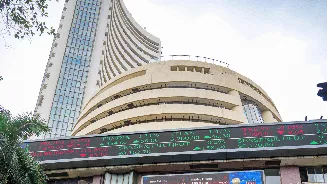








Broad-Based Selling Pressure
The Indian stock market recently experienced a significant downturn, with broad-based selling across various sectors. High-beta and growth-oriented stocks
were particularly affected. The technology sector bore a substantial brunt due to burgeoning fears surrounding Artificial Intelligence (AI) disruption and a general weakness in global tech markets, which considerably impacted major index components. Concurrently, metals and mining stocks saw sharp declines, reflecting softening global commodity prices and apprehension regarding demand trends from China. Energy stocks also weakened due to fluctuating crude oil prices, while sectors like autos, fast-moving consumer goods (FMCG), banking, and financial services witnessed consistent profit-taking as investors adopted a risk-off approach in the prevailing market climate. Key indices like the Nifty 50 closed down 336 points at 25,471, the BSE Sensex fell 1,048 points to 82,626, and the Bank Nifty lost 553 points, ending at 60,186.
AI Fears & US Economic Shadows
Stock market analysts attribute the recent surge in selling pressure to renewed anxieties about an economic slowdown, exacerbated by persistent inflation in the United States and other nations. The primary concern is that these inflationary pressures could eventually depress consumer demand, hinder job creation, and potentially lead to job losses, a scenario that the market is keenly anticipating. This fear is amplified by the Nasdaq's notable correction, having fallen approximately 5.50% from its recent one-month high of 23,857. Experts predict that further significant declines in this tech-heavy index, especially in double-digit percentages, could exert considerable downward pressure on the Indian stock market. Such a scenario might lead to the BSE Sensex potentially declining to the 60,000 mark and the Nifty 50 reaching around 18,000 levels by the conclusion of the fiscal year 2026-27.
Investor Vigilance & Nasdaq's Role
Investors are being strongly advised to take the recent stock market downturn seriously, given its widespread nature and the external catalyst of AI disruption. This concern has already triggered substantial selling in prominent Nasdaq-listed tech giants like NVIDIA, Apple, Alphabet, Meta, and Microsoft. Following intensified selling, the Nasdaq index has already seen a 5.50% correction from its one-month closing high of 23,857. Market participants are urged to closely monitor the performance of the Nasdaq index. A robust rebound in the initial trading sessions of the following week, characterized by more than just a 'dead-cat bounce' (a temporary recovery that fails to sustain), is crucial. A failure of the Nasdaq to recoup its recent losses could signal a deepening slowdown in the US economy, potentially intensifying selling on Wall Street and subsequently impacting global bourses, including India's Nifty 50 and Sensex.
US Slowdown Signals & Indian Impact
Current economic indicators in the US, such as rising inflation (up 0.30% to 2.40% in January 2026) and the Federal Reserve's struggle to maintain inflation within its 2% target, point towards potential slowdown symptoms. Despite headline job growth, US workers continue to face economic challenges including high living costs, job insecurity, and limited wage increases. Reports indicate a multi-year low in US job openings and hiring rates, raising concerns about economic health, though a broad downturn isn't yet definitively established. Goldman Sachs previously forecasted a period of 'jobless growth' in America due to new technologies like AI enabling companies to operate with fewer employees. A sustained weak performance in US markets, particularly a 'dead-cat bounce', could signal an approaching slowdown whose impact might become visible in the US stock market by the third quarter of the current year and persist for at least two years. For India, this slowdown could start affecting markets from early October 2026, especially if IT stocks, which have already faced a prolonged bear phase since February 2022, fail to recover from AI-induced selling.
Projected Indian Market Correction
The potential US economic slowdown could translate into a significant correction for Indian stock indices, with estimates suggesting a decline of around 30% from current levels by the end of FY 2026-27. Under this scenario, the BSE Sensex might fall to approximately 60,000, and the Nifty 50 could reach the 18,000 mark by March 2027. In the short term, the intraday market sentiment remains weak. A further sell-off is anticipated if key support levels are breached; for instance, if the market falls below the 20-day Simple Moving Average (SMA) at 25,400 for the Nifty and 82,500 for the Sensex. A break below these levels could extend the correction to 25,300/82,200, with potential further declines to 25,150-25,100 for the Nifty and 81,700-81,500 for the Sensex. Immediate resistance for the bulls is seen at 25,600/83,100 for the indices, with a potential pullback towards the 50-day SMA around 25,800–25,900/83,700-84,000 if these levels are surpassed.