



Samosa Enters Awards
In a groundbreaking moment for Indian cuisine's global recognition, the samosa has achieved a significant milestone by securing an entry into the 2026
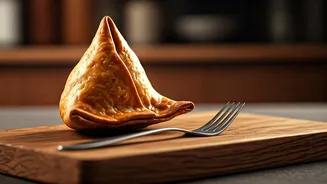
British Pie Awards. This marks the first time in the award's 18-year history that the popular deep-fried delicacy has been considered. The inclusion was championed by Keran Turakhia, widely known in the UK as '@samosawallah1', who ingeniously adapted the samosa to meet the awards' criteria. This novel development immediately ignited a spirited discussion about the fundamental nature of a samosa and whether it aligns with the traditional definition of a pie, particularly given the awards' requirement for baked entries.
Defining the Pie
To understand the samosa's eligibility, we must first establish what constitutes a pie. A pie is broadly defined as a baked dish characterized by a pastry crust encasing a filling, which can be either sweet or savoury. The crust itself is typically crafted from a mixture of flour, fat, and water, designed to form either a bottom crust, a top crust, or both enclosing the filling. Historically, sweet pies often feature ingredients like fruits, custards, or nuts. In contrast, savoury pies commonly incorporate fillings such as meats, vegetables, or cheeses, showcasing a wide culinary versatility that defines their place in various gastronomic traditions.
Pie's Ancient Roots
The concept of pies stretches back millennia, with its origins tracing to the ancient Egyptians around 2000 BCE. These early iterations were far simpler than their modern counterparts, featuring rudimentary crusts made from grains and water. These were primarily used to enclose sweet fillings, such as honey, creating a form of flat pastry pocket. This ancient practice laid the groundwork for the evolution of pies, demonstrating a long-standing human culinary desire to enclose and bake fillings within a dough-based casing, a principle that has endured and diversified over thousands of years.
What is a Samosa?
A samosa is a widely recognized deep-fried Indian snack, primarily made from refined flour, fat, salt, and oil. Its defining characteristic is a flavourful, often spicy, filling typically composed of boiled and mashed potatoes. However, the versatility of the samosa extends far beyond potatoes; it can also encompass a variety of other ingredients such as noodles, peas, cauliflower, minced meat, and even sweet additions like chocolate, offering a broad spectrum of taste experiences within its crisp, golden exterior.
Samosa's Middle Eastern Origin
The lineage of the samosa can be traced back to the 10th century within the Middle East region. Its earliest documented mention appears in the historical works of Iranian scholar Abolfazl Beyhaqi, where it was referred to as 'Sambosa'. In its initial form, the samosa was considerably smaller than its contemporary version. This compact size made it an ideal portable snack for travellers, easily storable in saddlebags and convenient for consumption on the go, highlighting its practical and adaptable nature throughout history.
Samosa or Pie Debate
The question of whether a samosa qualifies as a pie continues to spark varied opinions, but a key point of convergence exists: both fall under the broader category of filled pastries. In essence, both involve dough that is expertly shaped to enclose a filling before undergoing a cooking process. While the debate rages on, the samosa's recent inclusion in the British Pie Awards, albeit in a baked form, invites us to reconsider traditional classifications and celebrate the culinary ingenuity that bridges different food traditions, prompting enthusiasts to ponder this fascinating question.