






A Living Classroom
The Indian Women's Scientific Association (IWSA) in Vashi has cultivated a remarkable 'living rainforest' demo site, a testament to their mission of making
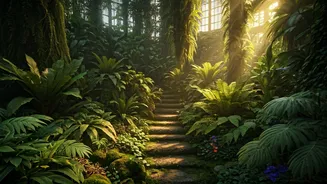
science accessible and engaging. Established in 2018, this Learning Garden features themed plant clusters, each no larger than a young baobab's girth, designed to illustrate ecological principles and the services ecosystems provide. The central rainforest exhibit, enclosed by a seven-foot tree ring, boasts a prominent copperpod tree (Peltophorum pterocarpum) surrounded by octopus trees (Schefflera actinophylla) and a variety of shrubs, grasses, and ground cover. A detailed floor plan aids visitors in understanding the layout. Adjacent to this, other distinct demo ecosystems like the Western Ghats, Deccan Plateau, and Coastal Belt are recreated, each a carefully curated mix of plants representing its specific biogeographical zone, functioning like living botanical displays.
Diverse Botanical Treasures
Beyond the rainforest, the IWSA garden is a vibrant tapestry of specialized botanical collections. Visitors can marvel at dedicated sections for butterflies, sensory plants, and resilient cacti. There are displays showcasing elegant orchids and air-purifying indoor plants like the Dracaena trifasciata, commonly known as mother-in-law's tongue. The garden also highlights plants with practical applications, such as Jatropha curcas, a source for biodiesel, and medicinal species like Cissus quadrangularis, the bone-setting hadjod, recognized for its healing properties. Other fascinating exhibits include fruiting plants like the ber (Ziziphus mauritiana), ancient prehistoric flora such as the cardboard plant (Zamia furfuracea), dye-yielding plants like the lipstick plant (Bixa orellana), and flowers named after musical instruments, exemplified by the fiddle-leaf champa (Plumeria pudica). An arboretum and a section dedicated to wild food plants further enrich this extensive collection.
Educational Outreach & Community
This extensive collection, comprising over 500 species, serves as an invaluable educational resource, attracting a diverse range of visitors including school and college students, local children, botany and medicine scholars, and even landscape architects and designers seeking inspiration. The IWSA has also launched a comprehensive guide, ‘Creating Learning Gardens & Living Museums: Biodiversity, Conservation & Sustainability,’ an illustrated handbook that makes setting up biodiverse gardens accessible. This initiative has already inspired similar projects, like the one in Palghar’s Navaze village. Naturalist Vijaya Chakravarty explains that stories and visual cues are integral to learning; for instance, the hadjod's bone-like appearance links to its medicinal use for fractures, and its use in chutneys. Similarly, the 'scholar tree' (Alstonia scholaris) is revered as the abode of the goddess of knowledge, connecting it to cultural practices like Tagore's gifting of its leaves to graduating students. The consistent weight of Abrus precatorius seeds, once used for weighing gold, is another fascinating historical detail shared.
Sustaining the Sanctuary
Despite its educational and environmental significance, the IWSA garden faces financial challenges that impact its maintenance. A lack of adequate funding prevents the hiring of a full-time gardener and hinders the acquisition of necessary materials and manure, according to garden coordinator Dr. Srirupa Mukherjee. To manage operations effectively, thematic sections are assigned to IWSA members. While scientists often cover immediate expenses personally, acquiring new plants relies on community efforts like plant swaps and gifts from affiliated institutions. For example, a unique specimen of Pterygota alata ‘diversifolia,’ known as pagal patta, was a gift from the Bhabha Atomic Research Centre. This situation is humorously likened by Chakravarty to the tree itself, where each distinct leaf symbolizes the unique individuality of the women involved in IWSA, highlighting their collective effort in maintaining this precious green space despite resource constraints.