



The Celestial Convergence
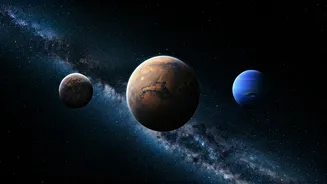
Prepare for an exceptional astronomical occurrence as the night sky offers a rare treat: a gathering of four distinct planets. Mercury, Mars, Saturn, and
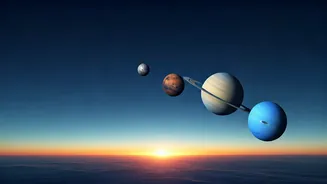
Neptune will converge, appearing in proximity from April 16th through April 23rd. This limited timeframe presents a unique opportunity for sky gazers to simultaneously observe a multitude of celestial bodies. For residents of India, this remarkable alignment will be an observable phenomenon, contingent upon favorable weather conditions and a willingness to greet the day before dawn. The visual spectacle unfolds as planets, despite being vast distances apart in space, seem to line up due to their shared orbital path around the Sun, a plane known as the ecliptic. This shared trajectory from Earth's perspective creates the illusion of them being in close alignment, a captivating sight for any observer.
Timing Your Celestial Viewing
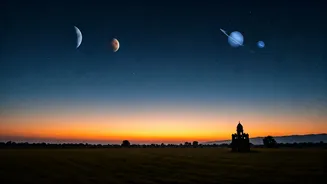
The prime time to witness this rare planetary alignment from India is approximately 30 minutes prior to sunrise, generally falling between 5:00 AM and 5:45 AM, with slight variations depending on your specific location. For the most impressive view of the planetary formation, aim to observe between April 18th and April 20th, as the planets will be most coherently arranged during these dates. To enhance your viewing experience, orient yourself towards the eastern horizon. It is highly recommended to find a location that is free from obstructions such as tall buildings and minimal artificial light pollution, which can significantly diminish the visibility of faint celestial objects. This alignment is not exclusive to India; it will be observable across various continents, including Asia, Europe, North America, and Australia, making it a globally anticipated event for astronomy enthusiasts.
Identifying the Planets
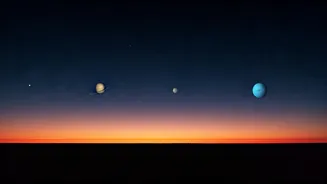
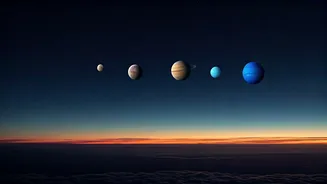
As you gaze towards the eastern horizon, you will notice the four planets arranged at different heights, forming a discernible row. Mercury, being closest to the horizon, might be challenging to spot due to the encroaching sunlight; however, its visibility is expected to improve as the alignment progresses towards April 20th. Slightly above Mercury, you'll find Saturn, distinguished by its gentle yellowish hue. While visible to the naked eye, employing binoculars will undoubtedly refine your perception of this gas giant. Mars will present itself more prominently with its unmistakable reddish-orange coloration, positioned higher in the sky and thus easier to pinpoint. Neptune, the most distant and faintest of the group, will likely be imperceptible without the aid of binoculars or a small telescope, requiring a bit more effort to locate amidst the celestial panorama.
The Evolving Cosmic Dance
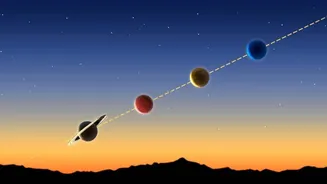
What makes this particular planetary alignment especially captivating is the dynamic nature of the planets' arrangement over the course of the event. Initially, you might perceive the planets forming a configuration that resembles a triangle in the sky. However, as April 20th approaches, this pattern will begin to shift, evolving into a more diagonal line. This gradual transformation offers a unique opportunity to observe and appreciate the subtle, yet constant, movement of celestial bodies, showcasing how their relative positions change over a matter of mere days. Witnessing this celestial ballet firsthand provides a tangible connection to the grand cosmic clockwork that governs our solar system.
A Fleeting Cosmic Window
Rare astronomical events like this compact and clear four-planet alignment do not occur frequently. While groupings of three planets are relatively common, encountering four planets together in such a cohesive manner is a genuinely exceptional occurrence. For those committed to waking up in the early morning hours, this week-long celestial display provides a straightforward yet profoundly memorable way to engage with the cosmos. Most of the planets in this alignment can be observed without specialized equipment, democratizing the experience and making it accessible to a wide audience. It's a brief but precious interval for skywatchers to connect with the vastness of space from their vantage point on Earth.