






The Legend of Kallu Kumhar
Nestled within the verdant, remote hills of northern Tripura, approximately 178 kilometers from the state capital Agartala, lies Unakoti, a site of profound
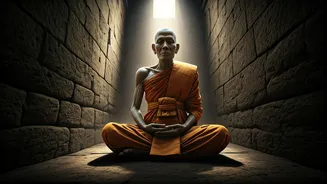
archaeological significance. The name itself, translating to 'one less than a crore,' hints at the captivating folklore surrounding its origin. A pervasive legend suggests that a staggering 99,99,999 stone images were meticulously carved here in a single night. The tale recounts the journey of Kallu Kumhar, a devout follower of Shiva, who was traveling to Kashi with an entourage of gods and goddesses. They paused their pilgrimage at this very location. Kallu Kumhar had cautioned his divine companions to awaken before dawn to resume their travels. However, as morning broke, he found himself the sole one awake. The rest, lost in deep slumber, were consequently cursed, their forms forever immortalized in stone, forming the immense collection of sculptures that define Unakoti.
Colossal Rock-Cut Masterpieces
Beyond the legend, Unakoti presents a breathtaking reality: a vast open-air gallery adorned with monumental rock-cut sculptures and intricate carvings. Towering figures, some reaching an impressive 30 feet in height, dominate the landscape, while entire cliff faces are covered in detailed bas-reliefs. Countless smaller carvings are scattered throughout the dense forested ravines, adding to the site's mystique. The undisputed centerpiece is the magnificent Unakotiswara Kal Bhairava, a colossal head of Lord Shiva that commands the area with its sheer presence and masterful craftsmanship. This commanding figure is surrounded by depictions of Ganesha, various forms of the goddess Durga, and numerous other deities. The site also features carved water channels, ancient pools, and areas that appear to have served as ritualistic spaces, all sculpted directly into the natural hillside, showcasing an extraordinary fusion of art and geology.
Artistry and Scale Revealed
The artistic prowess displayed at Unakoti is nothing short of astonishing. These are not rudimentary folk carvings; they are sophisticated works of art demonstrating an advanced understanding of proportion, perspective, and the inherent challenges of sculpting living rock. The artisans exhibited remarkable ingenuity in adapting their compositions to the natural contours of the stone, often ingeniously incorporating existing rock formations into their designs. The sheer magnitude of this undertaking points to a highly organized effort, requiring substantial resources, exceptionally skilled artisans, and, crucially, a profound depth of devotion. The meticulous execution and grand scale suggest a cohesive vision and a communal dedication to creating a sacred space of immense spiritual and artistic value that has endured through the ages.
Unraveling Historical Mysteries
Despite its grandeur, Unakoti remains enshrouded in historical uncertainty. The creators of these remarkable carvings and the precise era of their creation are subjects of ongoing debate. Scholarly estimates for their age vary widely, ranging from the 7th to 9th centuries CE to as late as the 11th to 12th centuries. Some researchers identify stylistic influences from the Pala dynasty's artistic traditions, while others perceive connections to indigenous tribal art forms prevalent in the region. The persistent absence of inscriptions or contemporary written records leaves archaeologists to rely on stylistic analysis and informed conjecture. This lack of definitive historical markers only adds to the enigmatic allure of Unakoti, prompting speculation about its creators and their motivations.
Remote Location Enigma
The remote and secluded location of Unakoti further deepens its historical puzzle. The question arises: why would such an ambitious religious project be undertaken in a region that must have been, even in ancient times, relatively inaccessible? One possibility is that Unakoti was strategically situated along ancient trade or pilgrimage routes that have since been lost to time. Alternatively, the very isolation of the site might have held spiritual significance, serving as a sacred nexus where the veil between the earthly realm and the divine was exceptionally thin, allowing for the profound act of carving deities into the very mountainside. This seclusion has undoubtedly contributed to the preservation of the site and its enduring mystery.
A Neglected Heritage
Unakoti serves as a potent reminder of the vast and often inadequately documented cultural heritage that exists across India, particularly in its northeastern states, whose rich histories are frequently overlooked in broader national narratives. This site, which rivals better-known rock-cut monuments elsewhere in the country, remained largely unknown outside Tripura until relatively recently. The ongoing mystery surrounding Unakoti is unlikely to be fully resolved soon, and perhaps it never will be. However, the experience of walking among these ancient stone figures offers more than just an appreciation of artistic achievement; it confronts visitors with the limitations of our historical knowledge and the profound depths of human devotion, a testament to a faith that was powerful enough to move mountains.