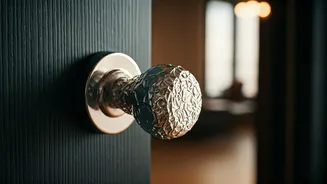








A Curious Trend Emerges
In 2026, a novel home innovation swept across the United States, capturing the attention of social media and homeowners alike. This peculiar trend involves
meticulously wrapping everyday door handles with aluminum foil. What initially appears as a whimsical DIY experiment has rapidly evolved into a widely discussed, low-cost remedy for a range of household issues, from mitigating those annoying static electricity shocks to bolstering home security. This phenomenon prompts a crucial question: is this merely another fleeting internet fad, or is there a tangible scientific basis underpinning its supposed effectiveness? Emerging reports and established scientific principles suggest the reality lies somewhere between these two extremes, indicating that while the trend may tap into legitimate physics and behavioral psychology, experts caution against viewing it as an infallible solution.
The Science of Static Reduction
The effectiveness of aluminum foil on door handles, particularly concerning static electricity, is grounded in fundamental principles of electrostatics. Static shocks often occur in dry indoor environments, exacerbated during winter or when air conditioning systems are in use. During these conditions, electrical charges can accumulate on conductive surfaces like metal door handles. Aluminum foil, being a highly conductive material, plays a key role in mitigating these shocks. Its conductive nature allows any accumulated electrical charge to disperse evenly across its surface rather than concentrating in a single spot. This increased surface area and even distribution effectively lower the potential for a sharp, localized electrostatic discharge. In essence, instead of experiencing a potent jolt from a concentrated charge, the electricity is spread out, significantly reducing the intensity and sting of the shock, making for a more comfortable interaction with your door handles.
Security Deterrent Potential
The notion that aluminum foil on door handles can deter burglars is a more contentious claim, yet it possesses some psychological underpinnings. Proponents suggest that the crinkling sound made when the foil is disturbed might alert homeowners to movement, and the visible presence of the foil could signal tampering or an unusual security measure. There is a psychological basis for this: research indicates that opportunistic intruders are more likely to be deterred by unusual or attention-grabbing modifications to entry points. Even subtle changes, such as the reflective nature of foil, can potentially signal that a home is less appealing to casual trespassers who are merely scouting for easy targets. However, experts emphasize that this acts solely as a deterrent, not as a complete security fortification. Foil can be removed quickly, and it offers no physical barrier to determined individuals. The viral popularity of this hack is likely amplified by a broader behavioral pattern where individuals feel a greater sense of security when they perceive any form of security measure, however minor. This perceived safety, even from low-effort, visible interventions, can increase occupants' sense of well-being, explaining the hack's widespread adoption due to its affordability, instant application, and visual presence.
Why This Hack Went Viral
Several converging factors have propelled the aluminum foil door handle trend into widespread popularity in 2026. Economically, with rising global costs, many homeowners are actively seeking free or low-cost alternatives to expensive security systems and home improvement solutions. This trend perfectly aligns with that financial prudence. Furthermore, platforms like TikTok have become breeding grounds for innovative and unusual home ideas, encouraging users to experiment with unconventional methods. The prevalence of dry indoor air, a common issue associated with heating and air conditioning, has also heightened the frequency of static shocks, making people more receptive to quick fixes like the foil hack. The combination of economic necessity, social media influence, and the need for immediate solutions to common annoyances has created a fertile ground for this seemingly simple yet effective trend to take hold and spread.
Limitations and Real Security
Despite its appealing simplicity and perceived benefits, experts consistently caution that aluminum foil is not a substitute for robust home security measures. Its limitations are significant: it offers no physical barrier, failing to reinforce locks or doors against forced entry. It is incredibly easy to remove, allowing potential intruders to peel it off in seconds. The sound detection capability is minimal; any crinkling noise may go unheard in larger homes or background noise. Furthermore, its effectiveness is inherently short-term, as foil can easily tear, wear down, or become damaged by moisture over time. While it might offer a marginal advantage, relying solely on foil for security is inadvisable. Experts advocate for more proven strategies, including the installation of deadbolts or smart locks, the deployment of motion-sensor lighting, the use of visible security cameras or video doorbells, and the improvement of external home lighting and general visibility. Even simple behavioral cues, such as leaving lights on or maintaining a well-kept exterior, have demonstrated a more reliable deterrent effect on intruders than improvised hacks.