




A Robotic Puzzle Master
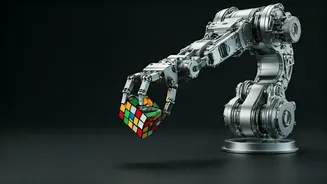
In a feat that might leave human speedcubers feeling a touch outpaced, a sophisticated robot has achieved an astounding record for solving a 4x4x4 Rubik's
Cube. British siblings Matthew and Thomas Pidden are the ingenious creators behind this mechanical marvel. Their invention secured a prestigious Guinness World Record by completing the complex puzzle in an astonishing 45.3 seconds. This groundbreaking demonstration of robotics and programming was first unveiled at the University of Bristol in May of 2025, stemming from an ambitious undergraduate project that blossomed into a world-record-breaking endeavor. The duo's creation showcases a remarkable fusion of mechanical engineering and advanced programming, pushing the boundaries of what automated puzzle-solving can achieve.
Innovation Meets Ingenuity
The spark for this record-setting robot originated from Matthew Pidden's university project, a perfect confluence of his lifelong passions: computer science and the intricate challenge of Rubik's Cubes. He expressed to Guinness World Records that the idea felt like a natural evolution, merging his childhood fascination with puzzle cubes and his academic pursuits in computer science. The robot's operational prowess lies in its sophisticated design, featuring four dedicated mechanical arms responsible for manipulating the cube's faces. Complementing this, two high-resolution cameras meticulously scan the cube's state. To ensure a fair competition and prevent any unfair advantage, the cameras are shielded by sliding plastic shutters, which are only revealed once each solving attempt commences, adding another layer of controlled precision to the process.
Record Smashed, Speed Achieved
The journey to the 45.3-second record was a progression of refinement and dedication. Initially, on their third attempt, the robot achieved a commendable time of 53 seconds, already a significant accomplishment. However, the brothers believed their creation possessed the capability for even greater speed. Through further fine-tuning and iterative testing, they reached their sixth attempt, where the machine delivered its ultimate performance, clocking in at the record-shattering 45.3 seconds. This swift resolution effectively outpaced the capabilities of most human solvers, highlighting the remarkable efficiency and precision of the robotic system developed by Matthew and Thomas Pidden.