




Ancient Origins Unveiled
The humble dupatta boasts an incredibly long lineage, stretching back over 3,000 years to the Indus Valley Civilization. Evidence of its earliest form
can be seen in artifacts like the famous 'Priest-King' sculpture, which depicts a cloth draped over the shoulder, resembling a chaddar. During the Vedic period, this garment was known as an 'uttariya'. Intriguingly, it was originally a practical, unstitched cloak worn by both men and women, serving dual purposes of protection from the elements and maintaining modesty. At this early stage, the emphasis was on the technique of draping and folding the fabric, rather than its material composition, highlighting its functional significance in ancient Indian society.
Mughal Grandeur and Luxury
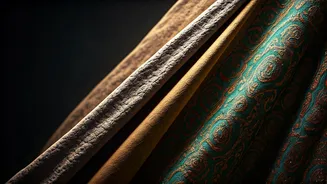
The arrival of the Mughals marked a significant turning point for the dupatta, elevating it from a utilitarian item to an emblem of opulence and high fashion. Influenced by Persian aesthetics, the royal courts began incorporating rich and luxurious fabrics into its design, such as fine silks, plush velvets, and intricate brocades. For noblewomen of both Hindu and Muslim faiths, the dupatta became an integral part of the purdah system, a practice emphasizing modesty. However, rather than becoming a subtle element, these women transformed the dupatta into a bold statement piece. They adorned it with lavish embellishments, including pearls, precious gemstones, elaborate embroidery, and the glittering zari work using gold and silver threads, turning it into a canvas of wearable art.
Gender Norms and Honor
The dupatta's narrative is intrinsically intertwined with the evolution of gender roles and societal expectations in India. For generations, it was deeply associated with a family's 'izzat,' or honor, and was often used to enforce a specific archetype of a 'virtuous woman.' The act of covering one's head or chest with the dupatta was not merely a stylistic choice but a societal mandate, perceived as evidence of a woman's purity, dignity, and respect for elders. While this patriarchal interpretation has historically been strong, contemporary urban fashion has initiated a significant shift. Today, although the dupatta is still revered and worn as a sign of respect in religious settings like temples, mosques, and gurdwaras, its role outside these sacred spaces has largely transformed into an optional element for personal style expression rather than a compulsory modesty requirement.
Regional Artisanal Expressions
As the dupatta journeyed across the Indian subcontinent, it absorbed and reflected the diverse artistic traditions of various regions, transforming into a vibrant tapestry of craftsmanship. Each distinct style offers a glimpse into the unique heritage of its origin. For instance, Punjab is renowned for its 'Phulkari,' characterized by bold, geometric floral embroidery. Varanasi contributes the opulent 'Banarasi' weave, famous for its heavy gold and silver zari work, embodying pure luxury. Gujarat and Rajasthan present 'Bandhani,' a meticulously crafted tie-dye technique creating precise dotted patterns. Lucknow offers 'Chikankari,' elegant white-on-white embroidery with intricate textures, while Andhra Pradesh showcases 'Kalamkari,' featuring hand-painted or block-printed cotton fabrics adorned with detailed mythological narratives.
Bollywood's Cinematic Influence
By the close of the 20th century, the Indian film industry, particularly Bollywood, played a pivotal role in reshaping the cultural perception and presentation of the dupatta. For those who grew up in the 1990s, the dramatic imagery of sheer chiffon dupattas, amplified by the ubiquitous wind machines on screen, is a lasting memory. These cinematic portrayals cemented the dupatta as a potent symbol of romantic ideals and a glamorous, essential accessory. This cinematic reinvention, in a way, brings us back to the recent 'Scandinavian Scarf' trend. While it can be irksome when global fashion borrows from ancient traditions without acknowledgment, the ensuing discussion served as a timely reminder that the dupatta is far more than just a matching accessory; it's a cultural artifact with a profound 3,000-year legacy.