






Understanding Lunar Eclipses
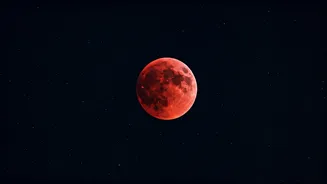
A lunar eclipse is a captivating astronomical phenomenon that occurs when our planet, Earth, positions itself directly between the Sun and the Moon. During
this alignment, Earth casts its shadow upon the lunar surface, obscuring the Moon's usual brightness. This shadow can cause the Moon to appear dimmer, and in some instances, it might even take on a reddish hue, often referred to as a 'Blood Moon.' While lunar eclipses happen multiple times annually, their visibility from specific locations, like India, is not guaranteed for every event. The March 3, 2026, eclipse is particularly noteworthy for its visibility across India, making it an event worth anticipating for skygazers.
Viewing the Eclipse Safely
Unlike its solar counterpart, observing a lunar eclipse is a remarkably simple and entirely safe endeavor. There is absolutely no need for specialized protective eyewear or equipment. On the evening of March 3, 2026, should the skies remain clear, all you need to do is step outside and look up at the Moon. While binoculars can offer a more magnified view, they are entirely optional and do not enhance the safety of viewing. Even with the naked eye, the subtle yet significant changes in the Moon's appearance as it passes through Earth's shadow will be clearly discernible. The eclipse is expected to be visible around dusk, making it an accessible event for everyone to enjoy.
Key Timings for India
For skywatchers in India, the total lunar eclipse on March 3, 2026, is scheduled to unfold with specific timings in Indian Standard Time (IST). The penumbral phase, where the Earth's faint outer shadow begins to touch the Moon, commences at 4:58 PM IST. Crucially, the period of totality, when the Moon is fully immersed in Earth's darker, inner shadow (the umbra), also begins at 4:58 PM IST. This phase of complete obscuration will last until 5:32 PM IST. Following this, the Moon will start exiting the umbra, with the penumbral phase concluding at 7:53 PM IST. However, it's important to note that in many parts of India, the Moon will be rising already within the eclipse's shadow, meaning only the latter part of the event will be visible.
Visibility Across India
The visibility of the March 3, 2026, total lunar eclipse in India presents a unique situation due to the Moonrise timing. For most of the country, the Moon will ascend above the horizon already partially or fully obscured by Earth's shadow. This means that skywatchers will primarily witness the latter stages of the eclipse. The most significant and observable portion for Indian viewers is anticipated to occur around sunset. Experts estimate that the visible window, during which the Moon emerges from Earth's shadow, will last for approximately 20 minutes. Therefore, the best time to look for the eclipse will be around dusk, when the rising Moon can be observed transitioning out of the shadow, eliminating the need to stay awake late into the night.
Northeast Sees Totality
According to available data from Time and Date, several cities situated in India's Northeast region are set to experience the complete totality of the lunar eclipse on March 3, 2026, with 100 percent obscuration. Among these locations are Dibrugarh and Dispur in Assam, where the maximum obscuration will occur. Itanagar in Arunachal Pradesh and Shillong in Meghalaya will also witness the full phase of totality. These cities offer the best vantage points for observing the Moon completely engulfed by Earth's dark shadow. The duration of totality for these northeastern cities is significant, contributing to a more immersive viewing experience for those fortunate enough to be in these areas.