




Sticky Foot Superpowers
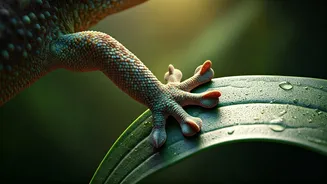
Geckos, those small, nimble lizards, possess a remarkable talent for adhering to virtually any surface, including sheer glass. This seemingly magical ability
stems from millions of microscopic, hair-like structures called setae covering their toe pads. These setae create a powerful bond with surfaces through van der Waals forces, essentially allowing the gecko to 'stick' wherever it goes. This unique adaptation grants them unparalleled mobility, enabling them to navigate vertical and inverted terrains with effortless grace, a feat far beyond human reach without specialized equipment.
Vibrant Visual Spectrum
The mantis shrimp boasts an evolutionary advantage in vision that dwarfs human capabilities. While our eyes are equipped with three types of photoreceptor cells to perceive red, green, and blue light, these marine crustaceans can possess up to sixteen different types. This extraordinary visual system allows them to experience a vastly richer and more complex spectrum of colours than we can comprehend, including wavelengths invisible to the human eye. This enhanced perception likely plays a crucial role in their predatory behaviour and communication within their underwater world.
The Art of Deep Sleep
Snails exhibit an astonishing capacity for prolonged dormancy, capable of entering a state of deep sleep that can last for up to three years. This survival mechanism, known as aestivation, is akin to hibernation but is typically triggered by extreme environmental conditions like prolonged drought or heat. It's a remarkable biological strategy that allows them to conserve energy and survive periods when resources are scarce, offering a stark contrast to humans' limited ability to endure extended periods of inactivity without serious consequences.
Unrivaled Head Rotation
Owls possess an exceptional ability to rotate their heads up to an impressive 270 degrees in either direction. This remarkable flexibility is not just for show; it's a vital adaptation for hunting. Since their eyeballs are fixed within their sockets and cannot move, owls rely on this extreme head rotation to scan their surroundings for prey. Their skeletal structure, featuring 14 neck vertebrae compared to humans' 7, along with specialized blood vessels that ensure continuous blood flow, allows for this incredible range of motion without compromising vital functions.
Gigantic Filter Feeders
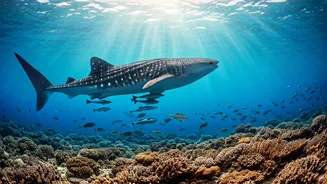
Despite their immense size, whale sharks, the world's largest fish, possess a surprising dental arrangement. They are equipped with thousands of teeth, potentially up to 3,000, yet these are not used for chewing or tearing. Instead, whale sharks are filter feeders, swimming with their mouths agape to strain plankton, small fish, and krill from the water through specialized gill rakers. This 'cross-flow filtration' system efficiently processes vast quantities of water, utilizing their numerous teeth more as a passive barrier than an active tool for consumption.
Incredible Relative Strength
Dung beetles, though small, are titans of the insect world when it comes to sheer strength relative to their body mass. Certain species have been observed to pull or push more than 1,000 times their own weight. To put this into perspective, this would be equivalent to a human dragging six double-decker buses! This extraordinary power is essential for their survival, enabling them to manoeuvre large balls of dung, which serve as their food source or a place to lay eggs, often across challenging terrain.