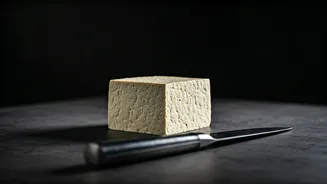








The Tofu Test
A peculiar social media phenomenon has emerged where women are using men's reactions to tofu as a gauge for their understanding of masculinity and femininity.
Videos circulating online capture men's responses to soy-based products, with the assertion that an intense aversion to tofu is intrinsically linked to a man's perceived level of masculinity and his societal standing. This trend suggests that a strong negative reaction to tofu isn't just about taste preferences but can be interpreted as a defense mechanism rooted in a fear of societal shifts or a misunderstanding of gender roles. The idea posits that such a reaction stems from a form of 'fragile masculinity,' where deviations from traditional masculine norms are met with hostility. This notion is amplified by the widespread, though often debunked, belief that consuming soy products can negatively impact male hormone levels, contributing to an uninformed resistance.
Beyond Taste Preferences
The connection between disliking tofu and what it signifies about masculinity appears to hold more weight than a fleeting trend. Experts suggest that tofu has evolved beyond a simple food item to become a symbol, representing stances on environmentalism and perceptions of food as either masculine or feminine. This association is further cemented by contemporary dating culture, which has historically reinforced the idea that manliness is synonymous with meat consumption. Historically, plant-based foods were often linked to nurturing and feminine qualities, while meat evoked imagery of the hunter and the provider. This dichotomy was famously explored in Carol J. Adams' 'The Sexual Politics of Meat,' which draws parallels between meat consumption, power dynamics, and societal oppression. Therefore, a man's rejection of tofu might not only reflect his dietary choices but also his broader worldview, including his views on femininity, cultural norms, and even political undercurrents, especially considering tofu's staple status in many Asian cultures.
Navigating Social Media Trends
While social media trends can offer interesting insights, it's crucial to approach them with a discerning eye, as they often transcend into real-life judgments. The assertion that a man's dislike of tofu definitively reveals his character or beliefs is an oversimplification. Personal preferences are just that—personal—and can be inconclusive about an individual's entire personality or perspective. Someone who avoids tofu might still possess progressive views on environmental issues, while a meat-eater could be highly environmentally conscious. Dating coaches emphasize the 'fundamental attribution error,' a common human tendency to infer a person's inherent traits from a single observed behavior. Labeling someone as toxically masculine simply because they don't like tofu ignores the complexity of individual personalities and experiences. A more constructive approach, as suggested by experts, is to ask broader questions like, 'What do you think about tofu?' This can open a dialogue to understand someone's underlying belief systems regarding power, subordination, and societal norms, rather than making sweeping assumptions based on a single food preference.