




Unveiling the Musk-Faced Machine
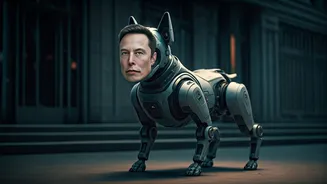
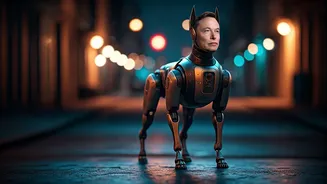
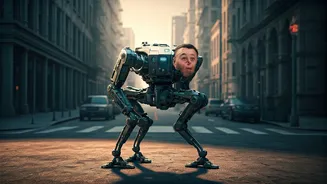
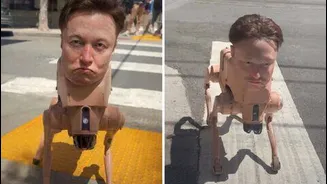
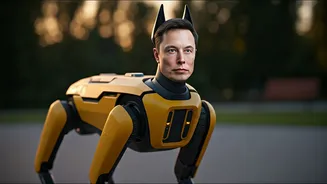
A truly unconventional scene unfolded in San Francisco as a robot dog, equipped with a remarkably lifelike face resembling tech mogul Elon Musk, was observed
traversing public areas. This peculiar technological creation, which appeared to be a modified version of a recognizable robotic canine, quickly became a sensation online. Videos and images of the automaton began circulating widely across social media platforms, eliciting a spectrum of responses from the public. Some individuals expressed admiration for the sheer ingenuity and playful nature of the concept, while others found the amalgamation of robotics and celebrity likeness to be unsettling, even bordering on eerie. The specific impetus or creator behind this intriguing robot remained initially unclear, but its presence undeniably captured widespread attention and initiated discussions concerning the evolving relationship between advanced technology, artistic expression, and public figures.
A Sight That Stopped Crowds
The appearance of this distinctive robot dog caused a noticeable stir in various public locales around San Francisco, including areas like Oracle Park and the SoMa district. Passersby, accustomed to the usual urban scenery, found themselves compelled to halt their routines upon encountering this unusual moving entity. What set this particular robot apart was not its mechanical nature but the remarkably accurate human face affixed to its head – that of Elon Musk. The hyper-realistic rendering of the facial features and signature hairstyle made the robot exceptionally conspicuous. Many onlookers were drawn to observe it more closely, their curiosity piqued to the point where they began capturing the moment on their devices, documenting this odd intersection of robotics and popular culture.
Beyond Machine, Towards Animacy
Adding another layer to its peculiar presence, the robot dog exhibited behaviors that transcended typical machine functionality. It wasn't merely moving; it engaged in actions that mimicked organic life, such as waving its limbs, assuming a squatting posture, and even performing a leg-lifting motion. In a particularly striking interaction, it responded with barks to actual dogs that approached it. These animalistic gestures contributed significantly to the illusion, making the robot appear more akin to a living creature than a mere piece of machinery. This anthropomorphic quality intensified the reactions of those witnessing the spectacle, blurring the lines between artificial intelligence and biological existence in a deeply curious way.
Real Dogs' Curious Encounters
The unusual robot also piqued the interest of actual canine companions it encountered. Several real dogs were observed approaching the robotic entity, investigating it with sniffs, vocalizing with barks, and circling around it. It was as if these animals were attempting to process and understand the nature of this novel, Musk-faced being within their environment. This interaction between the artificial and the organic provided an even more fascinating element to the already surreal scene, offering a unique perspective on how different forms of life might perceive and react to highly advanced robotic creations that mimic familiar forms.
The "Regular Animals" Project
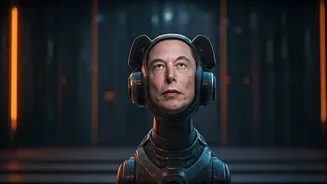
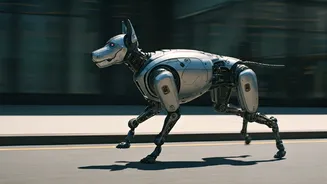
This attention-grabbing robot dog is, in fact, part of a digital art initiative known as "Regular Animals." This project is the brainchild of Mike Winkelmann, widely recognized in the art world as Beeple. The core concept of "Regular Animals" involves merging the sophisticated chassis of robot dogs, like those from Boston Dynamics, with incredibly lifelike silicone masks. These masks are crafted by skilled special effects artists, resulting in visages that are almost indistinguishable from real human faces. The Elon Musk iteration is just one instance; the project has also featured robots bearing the faces of other prominent figures, including Mark Zuckerberg, Jeff Bezos, Andy Warhol, Pablo Picasso, and even Beeple himself, as reported by News18, showcasing a broader exploration of identity and artificiality.
Art Beyond Visuals
The "Regular Animals" project extends its artistic ambition beyond mere visual presentation. In earlier iterations, these technologically enhanced robots were designed to actively engage with their surroundings by taking photographs. This captured imagery was then "printed" as an integral part of the artwork itself, as detailed by News18. This interactive dimension transformed the viewer's experience from passive observation to active participation, inviting people to encounter art in a more dynamic and memorable fashion. The integration of photography into the robot's function underscored the project's aim to blend art, technology, and public interaction in novel ways.
Promoting an Exhibition
The public appearances of these distinctive robots were strategically orchestrated as a promotional effort for Beeple's forthcoming exhibition titled "INFINITE_LOOP." This showcase was set to take place at a digital art center located in Palo Alto. As reported by the New York Post, the initiative aimed to make art more accessible and integrated into the fabric of everyday life by bringing it directly into public spaces where people naturally congregate. A representative involved in the project articulated the intention behind this approach, stating that the goal was to "stop people in their tracks and get them talking," thereby fostering engagement and discussion around contemporary art and its innovative forms.
Public's Divided Reception
The viral dissemination of the robot dog's exploits online has naturally resulted in a broad spectrum of public reactions. A significant portion of online commentators expressed sentiments of apprehension and discomfort, describing the sight as "terrifying" and "so wrong." Conversely, another segment of the audience found the spectacle highly entertaining, lauding it as "hilarious" and "brilliant." This pronounced divergence in opinions is precisely what has fueled the video's trending status, highlighting the complex and often contradictory ways in which the public engages with avant-garde artistic expressions and cutting-edge technology that challenges conventional norms.
Consent Concerns Raised
A notable aspect that remains unaddressed and subject to speculation is the matter of explicit consent. It is currently unclear whether Elon Musk himself, or any of the other public figures whose likenesses have been incorporated into the "Regular Animals" project, formally granted permission for their facial features to be utilized in this manner. As of the reporting, there has been no definitive confirmation or statement released to clarify this particular point, leaving a degree of ambiguity surrounding the ethical and legal implications of using celebrity visages on robotic platforms without explicit authorization.