



Giants of the Past
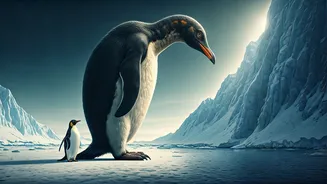
Our common image of penguins, often epitomized by the Emperor Penguin, doesn't capture their full evolutionary scale. Millions of years ago, penguin ancestors
were truly colossal. Fossil evidence unearthed in New Zealand points to a species named Kumimanu biceae, a formidable bird that could reach an impressive height of nearly 5 feet 11 inches and tip the scales at over 100 kilograms. These ancient giants dwarf modern penguins, highlighting a dramatic shift in their lineage over millennia.
Internal Salt Processor
Surviving in a saltwater environment without access to fresh water presents a significant challenge for any creature. Penguins, however, possess a remarkable adaptation: a specialized supraorbital gland situated just above their eyes. This sophisticated organ functions as a biological desalination plant, efficiently extracting salt from their bloodstream. The resulting highly concentrated salty liquid is then expelled from the penguin's body through a process akin to a sneeze, preventing detrimental salt buildup and ensuring their survival.
Waddle's Wise Physics
The seemingly awkward gait of a penguin, known as the waddle, is actually a brilliant display of biomechanical efficiency. This side-to-side swaying motion isn't a sign of clumsiness but rather a finely tuned method for conserving energy. By utilizing a pendulum-like effect with their short legs, penguins store and release energy with each step, effectively propelling themselves forward with minimal effort. This energy-saving locomotion is crucial for birds with significant body fat and limited limb length, allowing them to traverse icy terrains without expending precious calories.
Pebble-Based Society
Among certain penguin species, such as Gentoos and Adélies, a simple pebble holds significant social and economic value. These stones are not merely decorative but serve a crucial purpose in nest construction, providing a stable, elevated platform to protect eggs from the frigid ground. This necessity has fostered a unique 'pebble economy,' where males diligently search for the most appealing stones to present as courtship gifts to females. Consequently, this valuable commodity also fuels a level of 'petty crime' within colonies, as opportunistic individuals may attempt to pilfer desirable pebbles from unattended nests.
Camouflage for Survival
The distinctive black and white plumage of penguins, often referred to as a 'tuxedo,' is far more than a fashion statement; it's a critical survival mechanism known as countershading. This coloration provides excellent camouflage against predators from both above and below. When viewed from the dark depths of the water, a penguin's white belly blends seamlessly with the bright, sunlit surface, making it difficult for predators like leopard seals to spot them from below. Conversely, when seen from the sky, their black backs merge with the darker ocean floor, rendering them virtually invisible to aerial threats.
Diverse Habitats Flourish
Contrary to popular belief, not all penguins inhabit the frigid polar regions. The Galapagos penguin, for instance, thrives in an equatorial environment, demonstrating the remarkable adaptability of these birds. These tropical penguins have developed unique strategies to cope with the heat, such as panting like dogs to regulate their body temperature. They also benefit from the cooling influence of the Cromwell Current, allowing them to carve out a niche in surprisingly warm climates. This diversity underscores that penguins are incredibly versatile masters of the marine world, capable of flourishing in a wide range of environments.