




Echoes of the Past
For an extended period, glass bangles held a peculiar position in Indian fashion—ever-present yet frequently overlooked. However, a significant shift has
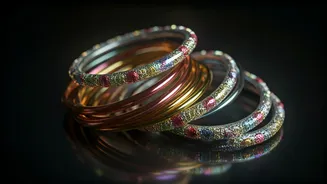
occurred, with these vibrant accessories now adorning the wrists of women embracing traditional attire and becoming a key element in the maximalist aesthetic favored by trendsetters. Designers and artisans are breathing new life into them with contemporary designs, making them popular as wedding return gifts and sought-after items in multi-brand jewelry boutiques. Whether this resurgence is fueled by a wave of nostalgia or the inevitable cycles of fashion, glass bangles are not merely reappearing; they are being recontextualized to resonate with a new generation, while their historical significance remains deeply rooted in Indian culture and craftsmanship.
Enduring Craftsmanship
The lineage of glass bangles stretches back to the era of the Mughals, with regions like Firozabad in Uttar Pradesh evolving into significant centers for their production. Even as the visual prominence of glass bangles may have diminished in early 2000s fashion narratives, the local economies dependent on their creation continued to flourish. The artisanal skill involved in their making persevered, consistently meeting the demands for both daily wear and special festive and ceremonial occasions. This continuity ensured that the craft remained a vital part of the cultural fabric, adapting to ongoing traditions and evolving tastes within communities that valued their intricate beauty and symbolic meaning.
Shifting Perceptions
The fading of glass bangles from mainstream fashion consciousness didn't occur uniformly across all segments of Indian society. While segments of the middle and upper classes gradually moved away from incorporating them into their wardrobes, women in working-class and non-urban settings continued to wear them as an integral part of their daily cultural expression, rather than as a fleeting trend. Digital influencer Rashi Sharma vividly recalls her early associations with glass bangles stemming from her mother's modest collection. She notes that they were perceived not just as mere adornments but as integral components of daily labor and life, their distinctive sound marking the rhythm of routines and their occasional breakage being an unceremonious aspect of the lives of domestic workers. This dual perception highlights how the bangles were deeply woven into the fabric of everyday existence for many.
Global Aesthetics
The gradual decline in the mainstream appeal of glass bangles mirrors a broader aesthetic shift that characterized the early 2000s. As global cultural influences became more pervasive, aspirational dressing began to lean towards international trends, often at the expense of distinct cultural expressions. A prominent curator and founder of the Annahmol label, vividly remembers having to consciously 'edit' her personal style while abroad. This involved deliberately abstaining from items perceived as excessive, noisy, or associated with everyday manual labor, reflecting a desire to conform to a more globally homogenized fashion standard that prioritized a certain perceived elegance and detachment from quotidian realities.
Reimagining Designs
Upon her return to India, the curator behind Annahmol began to view glass bangles and traditional Indian crafts through a renewed lens. She recognized that these pieces did not require toning down for broader appeal but could be thoughtfully reworked for a global audience. Her process involved deconstructing existing designs, experimenting with altered proportions, simplifying elements, and playing with color palettes. This creative exploration led to pieces that felt neither strictly traditional nor purely modern, but universally relevant. Having lived and worked in the United States, she approached these modifications with an understanding of what elements could effectively resonate across different international markets, bridging cultural divides through design innovation.
Collaborative Creations
Manasvi Bhushan, the founder of a burgeoning homegrown accessory brand, embarked on a journey to collaborate with the glass artisans of Firozabad, driven by a deep sense of curiosity and profound appreciation for their age-old craft. Through an intensive period of collaborative exploration alongside the skilled karigars, Bhushan ingeniously adapted traditional glassware-making techniques to create innovative bangles. This experimentation involved intricate processes such as silver fuming and meticulous adjustments to the thickness, texture, and color of the glass. The resulting collections, aptly named 'Dawn/Dusk' and 'Ebb/Flow,' subtly transform the common perception and experience of this iconic object. The 'Dawn/Dusk' bangles, with their captivating colors and reflective qualities, offer a versatility that distinguishes them from conventional glass bangles, while the 'Ebb/Flow' series incorporates suspended plasma, injecting an element of playful dynamism and visual intrigue.
A New Context
While glass bangles may have temporarily stepped out of fashion's spotlight, their current return is less about a simple revival and more about a fundamental shift in how they are styled and perceived. For Rashi Sharma, who now habitually wears stacks of bangles, this period represents a reclamation of an intrinsic part of her identity. She observes that individuals are increasingly drawn to elements that evoke familiarity, comfort, and cherished memories. As a content creator, she has also witnessed a move on social media away from overly polished imagery towards more authentic, personal storytelling. Glass bangles, with their inherent imperfections, fragility, and emotional resonance, fit seamlessly into this evolving landscape, offering a tangible connection to personal narratives and cultural roots.
Reclaiming Identity
As the Annahmol curator points out, what was once confined to traditional ensembles is now being reinterpreted by a generation that feels more empowered to express its identity without compromise. The significant change lies not in altering the object itself, but in redefining its context—a movement from mere revival to enduring relevance. For Sharma, this transformation is evident in the intuitive and effortless way glass bangles are now incorporated into everyday wear, retaining their delicate nature, distinct sound, and everyday appeal even within contemporary fashion frameworks. Bhushan attributes their renewed presence to the sheer joy they impart, as well as the evolving, collaborative dynamic between artisans and designers. Ultimately, this signifies not so much a renaissance of glass bangles, but a decisive evolution in perspective, where their wearing, styling, and visibility are being redefined on entirely new terms.