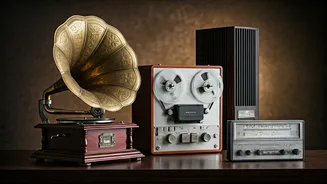








The Cylinder Era
In 1878, the world was introduced to the phonograph, a groundbreaking invention by Thomas Edison that marked the genesis of recorded music. This initial
device utilized wax cylinders to capture and reproduce sounds. Before this, music was solely a live experience. The phonograph cylinder made it possible to replay music, thereby making it accessible at any time. It opened a new chapter in how people would experience sound, transforming the musical landscape by offering repeated listening to recorded tunes.
Flat Discs Emerge
Emile Berliner's gramophone brought about a significant shift with the introduction of flat disc records in the early 1900s. These discs, unlike cylinders, quickly gained popularity. The advantage of the flat discs was that they enabled people to build music collections and, as playback machines became stylish household items, brought music into more homes. This development spurred a burgeoning music industry, as records could be produced in larger quantities and at a more accessible cost than the cylinders they were replacing, influencing how music was distributed and consumed.
The Rise of Vinyl
The 1940s ushered in the age of vinyl records, which would soon dominate the market until the 1980s. Vinyl proved to be a superior format; it was lighter and cheaper to manufacture when compared to shellac discs, making records more affordable for consumers. The evolution included both 7-inch singles and 12-inch albums. This development contributed significantly to the wider accessibility of music, particularly among youth and within the evolving landscape of popular music. This new technology provided more avenues for music consumption.
8-Tracks on the Go
The 1970s saw the emergence of 8-track cartridges, which provided a more convenient way to enjoy music, especially in automobiles. Though they had their drawbacks, like the repetitive loops that could disrupt the listening experience, 8-tracks marked a pivotal step towards mobile listening. They were a transitional technology, paving the way for more efficient and user-friendly formats that would follow. This shift was important in terms of how it prepared the consumer for personal listening devices in the future.
Cassettes and Walkmans
Audio cassettes entered the scene and further revolutionized music portability in the 1980s. They allowed listeners to create custom mixtapes, expanding music consumption beyond pre-recorded tracks. Sony's Walkman, a portable cassette player, was a game-changer. It redefined the way people listened to music by popularizing headphones and personal playback devices. This period saw music become a constant companion, integrated into daily life. The Walkman’s impact transformed how music was consumed.
CDs Usher Digital Age
The compact disc (CD) arrived on the scene during the 1980s and 1990s, offering what was marketed as “perfect sound forever”. CDs provided higher capacity than vinyl or cassettes, which enabled artists to structure albums differently. The superior digital sound quality and durability of CDs meant that many people discarded their older collections. The CD’s impact reshaped both the structure of music and how music enthusiasts curated their collections during this period, leaving a huge mark on how music was consumed.