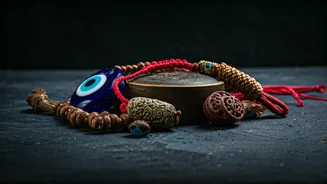








The Nazar's Watchful Eye
The Nazar, a mesmerizing blue bead with concentric eye-like patterns, is a universally recognized emblem of protection, deeply embedded in Mediterranean
and Middle Eastern cultures, especially Turkey and Greece. Its fundamental principle is to confront and redirect malevolent gazes back to their source. In India, it's a common sight, often affixed to the attire of newborns, displayed in vehicles, or worn as personal adornments like bracelets and necklaces. Households frequently place a Nazar near their main entrance, serving as a spiritual sentinel to deflect unwelcome energies. Beyond mere superstition, the Nazar functions as a psychological barrier, a visible emblem of reassurance that one is under a protective influence, fostering a sense of security and peace.
The Hamsa: Hand of Protection
The Hamsa hand, a distinctive palm-shaped amulet frequently featuring an eye design at its core, is a significant protective symbol prevalent in Middle Eastern and North African regions. The term 'Hamsa' itself translates to 'five,' signifying a potent combination of protection, blessings, and inherent strength. This amulet is often fashioned into jewelry or displayed as decorative wall art, embodying divine guardianship against envy and potential harm. In contemporary times, its appeal has transcended cultural borders, evolving into a sought-after spiritual accessory globally. The open palm of the Hamsa symbolizes both a defensive posture, pushing negativity away, and an inviting gesture, welcoming positive influences into one's life.
Salt's Cleansing Power
For millennia, salt has been revered for its purifying qualities. Within many Indian households, an age-old ritual involves elders ceremoniously swirling a handful of salt around an individual's head before discarding it, a practice aimed at neutralizing 'nazar.' A common domestic custom is to place bowls of rock salt in various room corners, with the belief that these crystals possess the ability to absorb detrimental vibrations. Furthermore, adding salt to bathwater is a popular method for energetic cleansing, particularly after experiencing emotionally taxing situations. Even outside of spiritual contexts, salt inherently represents renewal and grounding, offering a subtle yet tangible sense of re-establishment and revitalization through a simple physical action.
Black Thread's Subtle Strength
A simple black thread, often tied around the wrist, ankle, or waist, represents one of the most understated yet powerful protective measures found in Indian homes. The color black is thought to possess the quality of absorbing negative energies rather than repelling them. This practice is especially common for infants, who may wear it around their ankles, while adults often discreetly tie it to their wrists. In some families, a small prayer or mantra is recited during the tying of the thread, imbuing it with spiritual intention and reinforcing its protective purpose. The kala dhaaga, or black thread, is an inexpensive and unassuming symbol that embodies faith in its most pure and personal form: quiet, individual, and profoundly effective.
Lemon and Chillies' Repel
In India, it is a common sight to observe a lemon pierced with seven green chillies suspended outside shops, residences, and vehicles. This practice, known as 'nimbu-mirchi,' is a deeply ingrained folk ritual performed weekly. The prevailing belief is that the sourness of the lemon combined with the sharp pungency of the chillies acts as a deterrent against negative energies. Some traditional narratives suggest this offering is meant to appease Alakshmi, the goddess associated with misfortune, by presenting her with something bitter and spicy to dissuade her from entering and affecting the premises. Despite being viewed symbolically by many today, the ritual of replacing the nimbu-mirchi each Saturday remains a widespread protective custom.
Sacred Symbols as Shields
Across diverse religious traditions, specific sacred symbols are believed to confer divine protection. In Hindu homes, the auspicious 'Om' symbol or images of Lord Hanuman are often placed near entryways. Similarly, in Christianity, the cross is a widely worn emblem of faith and protection. Islamic tradition often incorporates recitations or displays of verses like Ayatul Kursi for safeguarding. These symbols transcend their physical form, acting as powerful anchors for faith and belief. Over generations, such practices have fostered a shared sense of reassurance, where visible manifestations of devotion quietly bolster inner fortitude, reminding individuals of a higher presence, offering solace during uncertain times, and transforming spaces into havens of spiritual security and emotional resilience. The very act of believing in these symbols often serves as a potent shield.