





The First Liquid Rocket
On March 16, 1926, a modest yet significant event unfolded in Auburn, Massachusetts. Robert H. Goddard, a physics professor with a visionary spirit, successfully
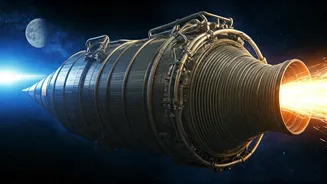
launched the world's first liquid-fueled rocket. This pioneering device, affectionately nicknamed "Nell," ascended a mere 41 feet into the air, traveling 184 feet before touching down. The propellant combination of gasoline and liquid oxygen, ignited in a controlled manner, proved that liquid propellants were viable for rocket propulsion, a stark contrast to the single-use nature of solid fuels. This brief flight, witnessed by his wife Esther, crew chief Henry Sachs, and colleague Percy Roope, marked the genesis of modern rocketry, a concept many of his contemporaries dismissed as fanciful dreams. Goddard meticulously documented this achievement in his personal diary, noting, "The first flight with a rocket using liquid propellants was made yesterday at Aunt Effie's farm in Auburn." This seemingly small 'hop' was, in fact, a giant leap for space exploration, laying the essential groundwork for future advancements.
Goddard's Enduring Innovations
Robert Goddard's contributions extend far beyond that initial launch. He is rightfully recognized as the 'Father of Modern Rocketry' due to a series of ingenious inventions that became the bedrock of rocket technology. His groundbreaking designs included crucial elements like turbopumps, which efficiently deliver propellants to the combustion chamber, and gimbaling engines, allowing for directional control of the rocket's thrust. Furthermore, his development of gyroscopic guidance systems provided the stability and precision necessary for navigating the complexities of flight. These innovations, initially developed and patented by Goddard, were instrumental in overcoming the technical hurdles that had previously limited rocket capabilities. His academic role at Clark University also allowed him to inspire future generations of scientists and engineers. The very principles he established are now honored by NASA's Goddard Space Flight Center, a testament to his profound and lasting impact on the field of space exploration and his crucial role in enabling missions that once seemed like science fiction.
Artemis 2: A Celestial Echo
Fast forward a century from Goddard's initial experiment, and his foundational principles are now propelling humanity back to the Moon. NASA's Artemis 2 mission, set to orbit the Moon with four astronauts, relies heavily on the technological lineage tracing back to Goddard's work. The massive Space Launch System (SLS) rocket, tasked with this lunar endeavor, incorporates the fundamental concept of liquid oxygen and fuel ignition, a direct descendant of "Nell's" propulsion system, although it also utilizes solid boosters for initial liftoff. This colossal rocket, approximately 30 times the size of Goddard's pioneering craft, stands ready at Kennedy Space Center's Launch Complex 39B. The Artemis 2 mission, scheduled for an April 1-6 launch window in 2026, will serve as a critical test for life support systems and operational capabilities in preparation for Artemis 3's planned lunar landing in 2027 and Artemis 4 in 2028, showcasing how a 100-year-old cabbage field invention continues to be pivotal in achieving humanity's ambitious space exploration goals.