



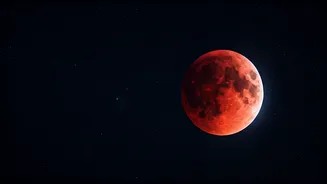
Eclipse Timings & Indian View
Mark your calendars for March 3, 2026, a date set to feature the first lunar eclipse of the year. For observers in India, this Chandra Grahan promises
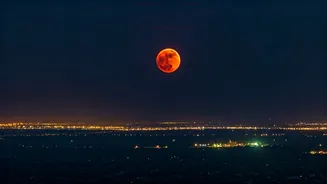
a unique viewing experience, albeit a brief one. The astronomical event officially begins with the penumbral phase at 4:58 PM IST, transitioning into totality at the same time. The period of full shadow will last until 5:32 PM IST, with the penumbral phase concluding at 7:53 PM IST. A crucial detail for Indian viewers is that the Moon will already be partially obscured as it ascends into the sky. This means that only the latter stages of the eclipse will be observable. The most striking part of the event, the visible shadow on the Moon, is anticipated to occur around sunset and last for approximately 20 minutes as the Moon gradually emerges from Earth's shadow. Consequently, there's no need for late-night vigils; a casual step outside during twilight should suffice for a glimpse of this astronomical phenomenon.
Northeast Visibility Highlights
For skygazers in India, the northeastern regions offer the prime vantage points for observing the total lunar eclipse. Cities in Assam and Arunachal Pradesh are slated to witness the full 100 percent obscuration of the Moon during the totality phase. In Dibrugarh, Assam, the eclipse begins at 2:14 PM IST, reaches its maximum at 5:11 PM IST, and ends at 7:53 PM IST, offering a total duration of obscuration lasting 3 hours, 27 minutes, and 8 seconds. Dispur and Guwahati, also in Assam, will experience totality from 2:14 PM to 7:53 PM IST, with their maximum eclipse occurring at 5:25 PM IST, sharing the same total obscuration duration. Itanagar, the capital of Arunachal Pradesh, will also see 100 percent obscuration from 2:14 PM IST, peaking at 5:17 PM IST and concluding at 7:53 PM IST, with the same 3-hour, 27-minute, and 8-second span. Shillong, Meghalaya, follows a similar pattern, with full obscuration from 2:14 PM IST, a maximum at 5:25 PM IST, and an end time of 7:53 PM IST, also experiencing the full 3 hours, 27 minutes, and 8 seconds of totality. These locations provide an exceptional opportunity to witness the Moon completely enveloped in Earth's shadow.
Understanding Lunar Eclipses
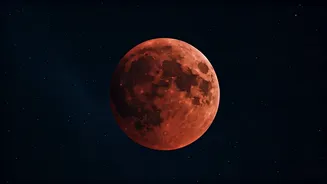
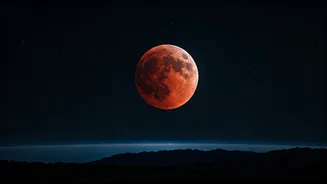
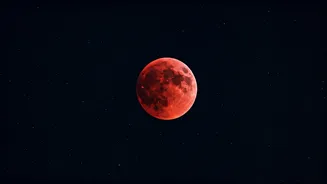
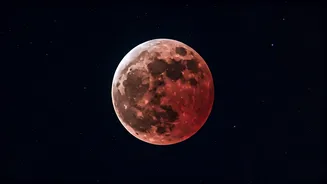
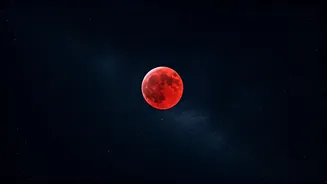
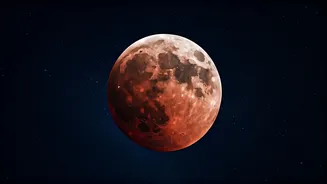
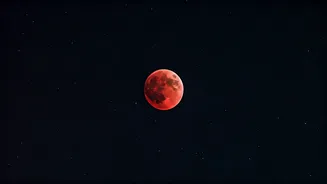
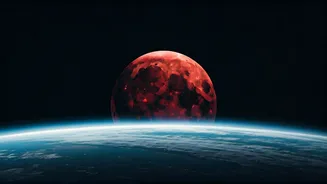
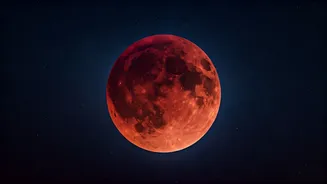
A lunar eclipse is a breathtaking astronomical event that occurs when our planet, Earth, positions itself precisely between the Sun and the Moon. This alignment causes Earth's shadow to be cast directly onto the lunar surface. As a result, the Moon dims, and under certain atmospheric conditions, it can take on a distinct reddish hue, often referred to as a 'Blood Moon'. While lunar eclipses happen a few times each year, not all are visible from every part of the globe. The specific alignment on March 3, 2026, makes this particular event noteworthy for observers in India. It's a natural celestial performance that requires no special equipment, only a clear sky and a moment to look upwards, offering a simple yet profound connection to the cosmos.
Effortless Viewing Guide
The beauty of a lunar eclipse lies in its accessibility; no specialized gear is required for viewing. Unlike solar eclipses, which necessitate protective eyewear due to the Sun's intense rays, lunar eclipses are perfectly safe to observe with the naked eye. As long as the skies are clear, all you need to do is step outside and direct your gaze towards the Moon. For those who wish for a more magnified experience, binoculars can enhance the view, allowing for a closer look at the subtle color changes and the details of the Moon's surface as it passes through Earth's shadow. However, even without any optical aids, the transformation of the Moon's appearance is clearly discernible. This upcoming eclipse on March 3, 2026, presents an easy opportunity for everyone, from seasoned astronomers to casual observers, to partake in a significant astronomical event. A simple reminder set for dusk, a clear view of the horizon, and the celestial show will unfold effortlessly.