







Anatomy of Stability
Elephants, renowned for their impressive size and intelligence, possess a unique physiological trait: they are incapable of jumping. This inability stems
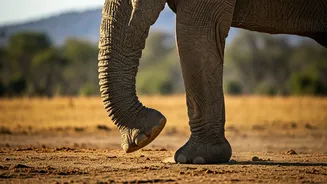
directly from their anatomy, which is fundamentally built for immense support rather than explosive movement. Unlike animals that jump, elephants lack the necessary flexibility in their lower legs, spring-like tendons, and deep joint flexion required to propel themselves airborne. Their legs are structured as thick, pillar-like columns with bones oriented vertically, ideal for bearing colossal weight but offering no elastic rebound. Furthermore, their ankles are relatively stiff, and their lower leg muscles are not as developed for leaping as those of smaller, more agile creatures. In essence, an elephant's entire physique is optimized for steadfastness and stability, allowing them to stand, walk, and move with incredible power and endurance across vast terrains, but not to achieve the airborne grace of a jump. Even the shape of their feet is designed to distribute pressure evenly, further aiding their stability rather than accumulating energy for a spring.
No Need to Leap
Beyond their physical structure, the evolutionary path of elephants has also shaped their movement capabilities, making jumping an unnecessary skill. Many smaller animals rely on jumping as a primary defense mechanism against predators, a means to overcome environmental obstacles, or simply for rapid locomotion. Adult elephants, however, are protected by their sheer mass and the collective safety of their herd. Threats are typically met with a forceful charge, an assertive warning, or the formation of a defensive circle, rather than an airborne escape. While they are not slow – capable of surprising speed and a distinctive running gait – they do not exhibit the kind of multi-limbed airborne movement seen in many other mammals. Scientific studies on elephant locomotion confirm that even at their fastest paces, their movement patterns remain distinct from traditional running or trotting gaits. This demonstrates that elephants are exceptionally capable movers, adept at navigating their world through powerful, stable movements, rather than aerial leaps.
Adaptation, Not Flaw
The inability of elephants to jump is not a biological deficiency but rather a masterful adaptation honed by millions of years of evolution. Their entire physiology is exquisitely designed to support an immense body weight, traverse vast distances efficiently, and maintain steady power for survival. This specialized design allows them to thrive in their environments, showcasing remarkable resilience and capability. Beyond their physical prowess, elephants are celebrated for their profound intelligence, complex social behaviors, and the incredible dexterity of their trunks, which they use with astonishing accuracy. Their unique way of moving, while lacking the jump, is perfectly suited to their needs, enabling them to manage their colossal size and interact with their world in ways that are both powerful and efficient.