
Autonomy on the Red Planet
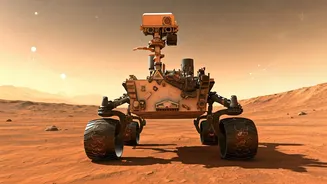
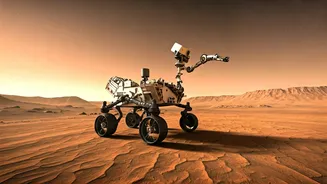
NASA is progressively enhancing the independence of its Mars rovers, a crucial development for exploring distant celestial bodies. Recently, the Perseverance
mission team conducted a significant test where artificial intelligence played a key role in plotting the rover's traverse across the Martian surface, largely eliminating the need for immediate human oversight. During a trial in December, waypoints meticulously generated by AI guided Perseverance through two distinct driving segments, covering a total distance of 456 meters (approximately 1,496 feet) entirely on its own. This demonstration underscores the remarkable advancements in autonomous capabilities and signals an expanded scope for exploring other worlds. NASA Administrator Jared Isaacman highlighted that these self-sufficient systems are vital for optimizing mission operations, particularly as spacecraft venture further from Earth.
The Need for Autonomy
The vast distance separating Earth from Mars introduces a substantial communication lag, with a round-trip signal taking about 25 minutes. This delay renders real-time control of rovers an impossibility, necessitating that they operate using their own onboard systems for extended periods. Traditionally, mission engineers on Earth meticulously analyze images and terrain data relayed from the rover. They then painstakingly map out routes, designating waypoints typically spaced no more than 100 meters apart. These navigation commands are subsequently transmitted via NASA’s Deep Space Network to orbiting satellites, which then relay them down to the Perseverance rover. However, in this recent groundbreaking trial, AI assumed a significant portion of this critical route-planning process, marking a substantial step towards greater robotic autonomy.
AI's Pathfinding Process
The sophisticated AI system employed for this mission meticulously examined high-resolution imagery captured by the Mars Reconnaissance Orbiter’s HiRISE camera, alongside detailed digital elevation models of the Martian terrain. Drawing upon this comprehensive data, the AI was adept at identifying potential hazards, including treacherous sand traps, substantial boulders, rugged rocky outcrops, and areas of uneven ground. Leveraging technology analogous to Anthropic’s Claude AI, the system then meticulously devised a secure route, marked by a series of strategically placed waypoints, specifically engineered to circumvent these identified dangers. Prior to its deployment on Mars, this AI-generated route underwent rigorous testing on Earth using a 'twin' rover, designated the Vehicle System Test Bed, housed at NASA’s Jet Propulsion Laboratory. This advanced engineering model provides a safe environment for teams to simulate potential challenges before transmitting any commands to the actual rover on Mars.
Rover's Autonomous Navigation
Once the AI-designed route received the necessary approval, it was transmitted to the Perseverance rover. Upon arrival, the rover’s integrated auto-navigation system seamlessly implemented the plan as it became active. A key capability that distinguishes Perseverance is its ability to interpret visual information while in motion, a significant improvement over some earlier rover designs. This means the rover can continuously process imagery as it drives, allowing for more dynamic and responsive navigation compared to rovers that might need to stop to analyze their surroundings. This real-time visual processing, combined with the AI-generated waypoints, empowers Perseverance to undertake complex traverses with a remarkable degree of independence.
The Horizon of AI Space
NASA has dedicated years to developing autonomous navigation systems, primarily driven by the necessity to overcome communication delays inherent in deep space missions. Despite these advancements, a limitation persists: the rover's awareness of its precise location can be somewhat diminished, a problem currently rectified from Earth through a time-consuming process. Researchers are actively exploring AI solutions to automate this 'relocalization' task, a breakthrough that could potentially enable longer and more ambitious explorations without the need for human intervention. Looking forward, AI is poised to assume an even more significant role across various space missions, from future Mars rovers to the ambitious Dragonfly mission targeting Saturn’s moon Titan. NASA officials believe intelligent systems will be indispensable for establishing a sustained human presence beyond Earth, bringing us closer to robots capable of independent thought and exploration.