



Mapping from Orbit
Traditionally, charting the ocean floor has been a painstaking process, with vast areas remaining a mystery even as we've mapped the moon's surface in detail.
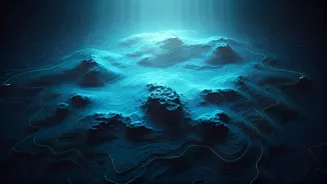
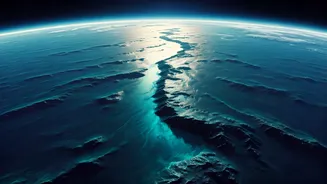
However, a significant leap forward is being made thanks to NASA's Surface Water and Ocean Topography (SWOT) satellite. This joint mission with CNES, launched in December 2022, operates by circling Earth and observing approximately 90 percent of the planet every 21 days. It doesn't directly see the seabed, but rather employs an ingenious indirect method. By meticulously measuring minute variations in water levels across the globe's oceans, lakes, and rivers, SWOT can infer the topography of the ocean floor hidden beneath the waves. This remarkable capability promises to accelerate our understanding of marine environments exponentially.
Gravity's Subtle Clues
The science behind mapping the seafloor from space relies on a fundamental principle: gravity. Massive underwater geological formations like seamounts and underwater mountain ranges possess more mass than the surrounding ocean floor. This increased mass exerts a slightly stronger gravitational pull on the water column directly above it, creating subtle bulges or elevations in the sea surface. The SWOT satellite is exquisitely sensitive to these minuscule water surface anomalies. By analyzing these tiny bumps and dips, scientists can effectively deduce the shape and features of the underwater terrain. Dr. David Sandwell, a geophysicist, highlights that SWOT represents a massive advancement, enabling the detection of features less than half the size previously possible, potentially increasing the count of known seamounts from 44,000 to a staggering 100,000.
Why Seafloor Matters
Understanding the intricate details of the ocean floor is far from an academic exercise; it holds profound practical implications. Accurate seafloor maps are crucial for enhancing the safety and efficiency of maritime navigation and shipping lanes, ensuring vessels can traverse waters without unexpected hazards. They are also vital for the strategic planning and installation of underwater communication cables, the backbone of global connectivity. Beyond infrastructure, knowledge of the seabed aids in identifying potential environmental dangers. Furthermore, detailed bathymetric data contributes significantly to the study of ocean currents, tidal patterns, and marine ecosystems, offering insights into the complex biological and physical processes that shape our planet's oceans. The ongoing mapping efforts also play a key role in advancing our comprehension of plate tectonics and the long-term geological evolution of Earth's crust.
Global Mapping Ambitions
The work conducted using SWOT data is a pivotal component of a broader international endeavor aiming to achieve a comprehensive map of the entire ocean floor by the year 2030. While ships equipped with advanced sonar technology remain indispensable for achieving the highest resolution measurements, satellites like SWOT provide an unparalleled advantage in surveying vast oceanic expanses rapidly. As Dr. Sandwell notes, full ship-based mapping by 2030 might be unfeasible, but SWOT's contribution will be instrumental in bridging the gaps, bringing the global mapping objective within reach. As the collection and analysis of this new data continue, scientists anticipate further refinements to these maps, marking this innovative approach as a monumental step in exploring one of Earth's most enigmatic and least understood frontiers.