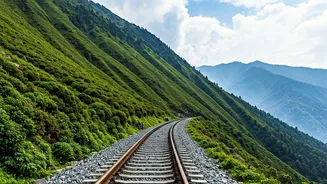







A State Beyond Rails
Sikkim, nestled in the majestic Himalayas, stands as a unique geographical anomaly within India, being the only state that has yet to be integrated into
the national railway network. This distinction is primarily a consequence of its exceptionally challenging topography, characterized by formidable mountain ranges, deep valleys, and ecologically sensitive landscapes. The sheer difficulty and cost associated with constructing railway lines through such rugged terrain, often requiring extensive tunneling, have historically precluded its development. Consequently, Sikkim has remained an outlier, a destination not directly accessible by train, preserving a certain remoteness that contributes to its allure. However, this isolation is not a permanent state, as significant infrastructural projects are underway to finally connect the state to the country's rail arteries, promising a new era of accessibility.
Bridging the Himalayan Divide
The narrative of Sikkim's railway connectivity is shifting, with a major project underway to link the state to West Bengal via a new railway line connecting Sevoke to Rangpo. This ambitious undertaking traverses approximately 44-45 kilometers of demanding Himalayan terrain, presenting formidable engineering challenges. The construction involves extensive tunneling and the building of numerous bridges across the picturesque Teesta valley, marking it as one of India's most complex railway initiatives. Significant progress has been made, with substantial portions of the project completed, and the line is anticipated to be operational by 2027. Upon its completion, this railway will dramatically enhance connectivity to Sikkim, with plans already in motion for future extensions towards Gangtok, thereby stimulating tourism and improving regional access for both residents and visitors.
Traveler's Gateway to Sikkim
For those eager to experience Sikkim's pristine beauty, several practical travel routes are available, ensuring the journey is as memorable as the destination itself. The most conventional method involves a train journey to New Jalpaiguri (NJP) in West Bengal, a major railway hub well-connected to cities like Delhi and Kolkata. From NJP, travelers can opt for road transport; Siliguri, located nearby, offers a plethora of options including shared jeeps, taxis, and buses that make the scenic four to five-hour drive to Gangtok, following the banks of the River Teesta. Alternatively, air travel offers a quicker, though sometimes weather-dependent, route. Sikkim's own airport at Pakyong is situated about 30 kilometers from Gangtok, but flights can be infrequent. A more reliable aerial option is to fly into Bagdogra Airport, which boasts better connectivity across India, and then proceed to Gangtok by road, a journey that takes approximately four to five hours. For the adventurous, driving into Sikkim from West Bengal provides a spectacular road trip experience, allowing for a gradual immersion into the mountainous landscape, making it a favorite for road trip enthusiasts and bikers.