





Himroo's Mughal Blend
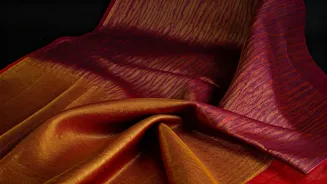
Originating from Aurangabad with deep historical ties to the Mughal era, Himroo is a sophisticated amalgamation of silk and cotton. The name itself, derived
from the Persian 'Hum-ruh,' signifies a likeness to pure silk, offering the opulent appearance of heavy brocade while maintaining exceptional breathability, making it ideal for India's often-challenging climate. Unfortunately, the authenticity of genuine Himroo is frequently overshadowed by an influx of inexpensive power-loom imitations that misrepresent the traditional craft. This blend of luxury and comfort is a testament to ancient weaving ingenuity, providing a visually rich textile that remains comfortable to wear.
Mashru's Permitted Luxury
From Patan in Gujarat, Mashru—meaning 'permitted' in Arabic—emerged as an ingenious solution to religious dictates that forbade Muslim men from wearing pure silk directly against their skin. Weavers masterfully crafted this textile with a luxurious silk surface and a soft cotton interior, creating a fabric that offered both extravagance and comfort. This innovative weave represents a unique intersection of cultural practice and textile artistry, providing an exquisite feel without compromising adherence to tradition. However, finding authentic, handwoven Mashru has become an increasingly rare endeavor due to the prevalence of mass-produced alternatives.
Goa's Kunbi Check
Beyond its sun-drenched beaches, Goa holds a textile treasure in the Kunbi saree. Traditionally worn by tribal communities, this striking red-and-black checkered drape was skillfully created on backstrap looms. Its unique design allowed women to wear it short, without a blouse or petticoat, facilitating ease of movement for agricultural work in the paddy fields. The intricate weaving technique and cultural significance of the Kunbi saree were nearly lost due to the influence of Portuguese colonial dress codes and the rise of modern power looms. Today, with only a few artisans preserving the method, its breathable, minimalist aesthetic is perfectly suited for contemporary fashion, offering a piece of Goan heritage that is both stylish and historically resonant.
Patteda Anchu's Sustainability
Emerging from North Karnataka and tracing its origins back to the 10th century, the Patteda Anchu is a remarkable cotton saree celebrated for its ancient sustainability. This sturdy cotton weave features a distinct mustard or red border set against a checked body, offering exceptional practicality. Its most impressive feature is its reversibility, allowing it to be worn on either side, eliminating the need for a lining and extensive ironing. This zero-maintenance characteristic, combined with its eco-friendly nature, made it a beloved garment. Its decline coincided with the proliferation of inexpensive synthetic fabrics in rural markets, but its inherent qualities make it an ideal candidate for a modern, sustainable wardrobe.
Sungudi's Knotty Artistry
In Madurai, Saurashtrian weavers developed the Sungudi saree, a beautiful example of meticulous craftsmanship. The authentic process involves hand-tying thousands of precise knots onto fine cotton fabric before immersing it in natural dyes. This labor-intensive method results in a highly breathable textile, making it exceptionally suitable for the intense heat of Southern Indian summers. Unfortunately, the market today is largely saturated with imitations, with most fabrics sold as Sungudi being merely screen-printed replicas. The genuine Sungudi represents a tradition of natural dyeing and intricate detailing that is tragically being eroded by mass production.
Karvath Kati's Wild Silk
While the spotlight often shines on Paithani sarees, the Vidarbha region of Maharashtra is home to the equally elegant Karvath Kati. This saree is woven from pure, wild Tussar silk, lending it a unique, earthy luster. Its name is derived from the distinctive geometric borders, reminiscent of saw teeth, which are intricately woven into the fabric. The Karvath Kati possesses a natural, understated elegance that sets it apart from heavily embellished silks. Its weavers, however, face significant challenges in maintaining their craft against the dominance of more popular styles and synthetic alternatives, making its revival crucial for preserving regional textile diversity.
Siddipet Gollabhama's Story
The Siddipet Gollabhama saree is a unique textile that literally weaves narratives into its fabric, featuring delicate motifs of the 'Gollabhama,' or milkmaid, carrying a pot. These intricate designs are not added later through embroidery but are painstakingly integrated into the weave itself using a complex extra-weft technique. This method requires immense skill and time, making the production process incredibly labor-intensive. The challenge facing this exquisite craft lies in fair compensation; weavers often do not receive adequate payment for their slow, meticulous work, leading younger generations to abandon the art. The Gollabhama is a prime example of storytelling through textiles, a tradition at risk of being lost.