






The Viral Sketch
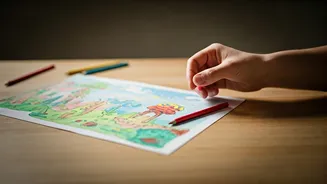
A father's online sharing of his child's peculiar drawing, depicting him joyfully plummeting from a roof while the rest of the family appeared somber,
sparked widespread online chatter. This incident, while amusing to some and concerning to others, prompted a deeper reflection on the nature of children's artistic expressions. It highlighted a common parental tendency to seek immediate, often alarming, interpretations in their children's artwork, rather than considering the diverse tapestry of a child's inner world. The drawing, with its seemingly contradictory elements of distress and delight, served as a powerful reminder that children's minds operate on different frequencies than adult logic, frequently weaving together observed reality, imaginative leaps, and raw emotional landscapes into a single, expressive visual narrative. This particular piece of art became a focal point for discussions about how adults perceive and respond to the often-unconventional ways children communicate their experiences and feelings, urging a shift from quick judgment to thoughtful curiosity.
Imagination vs. Interpretation
When we look at a child's creation, our adult brains often search for a linear narrative, a clear cause-and-effect. However, children's artwork is rarely a direct transcription of reality. Instead, it's a vibrant collage where a fleeting memory of a parent leaving for work might merge with the feeling of missing them, and then be amplified by a fantastical notion of flying or performing a heroic feat. This fusion means that a figure falling from a roof, far from signaling distress, could represent movement, change, or even sheer excitement for the child. The presence of a smile on the falling figure's face is a crucial cue, indicating that the child's perception of the event was not one of fear or peril, but perhaps of an adventurous or significant action. This disconnect between adult expectations of literal representation and a child's fluid, emotion-driven artistic process is often the root of misinterpretation, leading us to see danger where a child intended to convey dynamism or a playful exploration of concepts.
The Child's Perspective
The divergence in how adults and children interpret drawings stems from fundamental differences in our cognitive approaches. Adults tend to impose logic and established narrative structures onto visual information, seeking concrete meanings and potential problems. Conversely, children often create what can be described as 'emotional snapshots,' capturing feelings and abstract ideas rather than adhering to strict realism. A parent might perceive a falling figure as an indicator of danger or anxiety, whereas a child might be expressing a more nuanced observation: 'Dad is going somewhere,' or 'Dad is doing something significant,' or even 'Dad is distinct from us in this situation.' Children also possess an innate flair for dramatization, transforming ordinary scenarios like standing on a roof into a theatrical stage or a simple departure into an epic act. This exaggeration serves to make the drawing more engaging and to emphasize the emotional core of the experience they are trying to convey, leading to the classic adult-child interpretation gap where logic clashes with feeling.
Art as Expression
Beneath the surface of such unconventional drawings lies a profound truth: children frequently articulate sentiments and ideas that they lack the verbal vocabulary to express directly. A piece like the one described might be the child's way of processing a parent's absence or distance, perhaps exploring playful scenarios of departure and return. It can also serve as a vital outlet for working through emotions in a safe, imaginative environment. Therefore, it's crucial for parents to approach these artworks with curiosity rather than immediate alarm or outright dismissal. Instead of direct interrogation, engaging questions like 'Tell me about what's happening here,' 'What is everyone feeling in this picture?', or 'What happens next in the story?' can gently encourage the child to share their perspective. Often, the explanations are surprisingly straightforward; the 'falling' dad might simply be 'going somewhere,' and his smile a reflection of anticipation or excitement, underscoring the importance of understanding art as a child's nascent language.
A Child's First Language
Long before children master the complexities of spoken language, drawing serves as their primary means of communication and self-expression. These early artistic endeavors are far more than mere scribbles; they act as a dynamic record of a child's emotional landscape, providing invaluable insights into their inner world. Within the freedom of a blank page, children experiment with ideas, test boundaries, and begin to make sense of their experiences. Furthermore, art offers a unique avenue for connection, enabling children to share their thoughts and feelings with parents without the need for perfectly formed sentences or articulate explanations. This visual dialogue is fundamental to their development, allowing them to navigate their understanding of the world and their place within it, fostering a deeper bond between child and caregiver through shared interpretation and mutual understanding.