




Why Black Holes Matter
Black holes are not just fascinating celestial objects; they are fundamental to understanding the universe. They influence the structure and evolution
of galaxies, including our own Milky Way. Studying black holes provides insights into the nature of gravity and the ultimate fate of matter. Their intense gravitational pull serves as a cosmic laboratory, where the laws of physics are pushed to their limits. These extreme environments allow scientists to test theories and explore phenomena impossible to replicate on Earth. They help understand the universe's evolution and answer deep questions about space and time.
Supermassive Black Holes
At the centers of most galaxies, including the Milky Way, lie supermassive black holes. These behemoths can have masses millions or even billions of times that of our sun. They play a critical role in shaping galactic structure, influencing star formation, and regulating the growth of galaxies. Supermassive black holes actively feed on surrounding matter, emitting powerful jets and radiation in the process. This energy output affects the surrounding galactic environment. These immense objects are believed to have grown in tandem with their host galaxies, and their study offers vital clues about the cosmos.
Intermediate and Primordial
Intermediate-mass black holes (IMBHs) are another type of black hole. These have masses that are between those of stellar-mass and supermassive black holes. They are believed to exist, but they have been more difficult to detect. Their formation mechanisms remain an active area of research. Some theories suggest they may form from the mergers of smaller black holes or from the collapse of massive star clusters. Primordial black holes, another class, are hypothetical black holes formed in the early universe, potentially from density fluctuations. Their existence could have implications for understanding dark matter, but they are also very hard to confirm.
Giants, Ghosts, Gravity
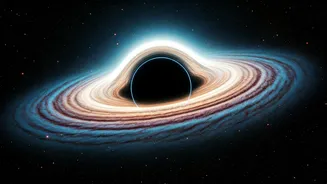
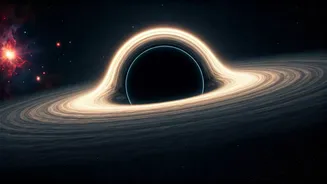
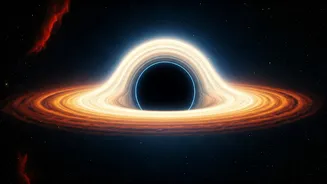
Black holes are often described as 'giants' due to their enormous masses and gravitational influence. They are also like 'ghosts' because their extreme gravity prevents anything, even light, from escaping. Black holes are known as 'gravity traps' because of the immense force they exert. Once something crosses the event horizon, the point of no return, there is no escape. The study of these fascinating objects helps physicists to examine how matter behaves under extreme conditions. Furthermore, they are crucial tools for testing theories about the nature of gravity and the very fabric of spacetime.
Are Black Holes Dangerous?
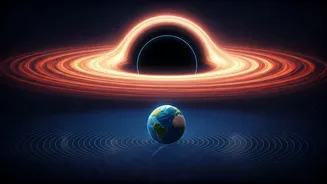
Black holes, despite their reputation, are not necessarily cosmic vacuum cleaners that indiscriminately devour everything in their path. The dangers depend on the proximity. At a distance, the gravitational effects are comparable to any other object of similar mass. If the sun were replaced with a black hole of the same mass, the Earth's orbit wouldn't change. However, if an object approaches too closely, it can be spaghettified, meaning stretched and squeezed into a long, thin strand. In any case, scientists continue to study and comprehend the influence of black holes on the universe.
From Stars to Galaxies
Black holes form from the remnants of massive stars that collapse at the end of their life cycle. These stellar-mass black holes can then grow by consuming surrounding matter. Over time, they can merge with other black holes, and eventually become supermassive black holes that reside at the center of galaxies. Black holes are integral to the evolution of galaxies. They drive galaxy formation by triggering the formation of stars and by expelling energy and matter. Their presence is fundamental to the structure and evolution of the universe itself, which means we must continue to learn more about them.
When Stars Collapse
Stellar-mass black holes form when massive stars exhaust their nuclear fuel and collapse. The core of the star collapses under its own gravity, creating a singularity, a point of infinite density. If the collapsing core is massive enough, nothing can prevent the star from becoming a black hole. When this event happens, the star's outer layers are often ejected in a supernova explosion, leaving behind the black hole. These black holes are typically a few times the mass of our sun. They can grow by accreting matter from surrounding space or merging with other black holes.