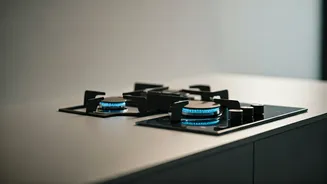







The Hydrogen Cooking Breakthrough
Amidst the recurring challenges with LPG supply, a remarkable innovation has emerged from India: a gas stove that operates entirely on green hydrogen.
This isn't just another cooking appliance; it's a compact, plug-and-play unit designed to generate its own fuel using just water and electricity. The promise is a cooking experience that is not only zero-emission but also remarkably quiet, offering a stark contrast to traditional methods. Currently priced at Rs 1,50,000 per unit, this advanced stove is initially being positioned for commercial and institutional kitchens, signifying a pivotal moment in the exploration of alternative energy sources for everyday culinary needs.
Unique Hydrogen Stove Technology
This pioneering gas stove distinguishes itself by running 100% on green hydrogen, featuring a two-burner configuration. While its countertop design and manual ignition resemble conventional stoves, its operational principle is fundamentally different. Developed by a firm named Greenvize, the unit ingeniously integrates a proton exchange membrane (PEM) electrolyzer. This allows for the on-demand production of hydrogen directly from ordinary water, eliminating the need for cumbersome gas cylinders or extensive pipeline networks. Each stove requires a modest 100 ml of distilled or RO water and approximately 1 kWh of electricity to provide up to six hours of cooking time. When compared to induction cooktops, which consume roughly 1.5-2 kW per burner, the hydrogen system's efficiency is notable, using around 1 kWh. A significant advantage is its compatibility with all types of cookware, unlike induction stoves that necessitate specialized pots and pans.
Eco-Friendly Operation Explained
The environmental credentials of this hydrogen stove are a major selling point. Experts highlight that its operation is completely emission-free, producing neither CO nor carbon monoxide, and generating no visible smoke. The cooking process is exceptionally quiet and vibration-free, making it an ideal choice for indoor environments where a clean and serene atmosphere is paramount. The sole byproduct of the hydrogen combustion is water vapor, positioning it as an exceptionally eco-friendly alternative to conventional cooking fuels. This focus on sustainability addresses growing concerns about air quality and the environmental impact of household energy consumption.
Commercial Potential and Cost
While the design could accommodate home kitchens, the immediate strategic focus for this innovative stove is broader, targeting large-scale applications. It is currently undergoing trials for use in community kitchens, canteens, government-backed clean energy initiatives, and various institutional and industrial kitchen settings. The substantial price point of approximately Rs 1,50,000 per unit currently precludes its widespread adoption in typical households. Instead, it is being presented as a pilot project with the potential to revolutionize cooking in environments where efficiency, sustainability, and safety are key priorities. Although it may not immediately replace LPG in domestic settings, it represents a significant stride towards exploring and implementing novel cooking methodologies for the future.