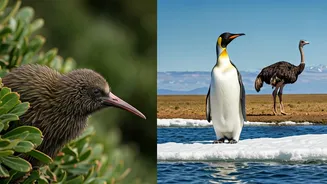







Ostrich: The Giant Runner
The ostrich stands as the largest avian species on Earth and is a prime example of evolution favoring terrestrial prowess over aerial ability. Native to
Africa, this magnificent bird cannot take to the skies. Instead, its biology is finely tuned for incredible speed and agility on land. Its exceptionally powerful and robust legs are its primary means of locomotion, enabling it to outrun predators with astonishing swiftness. While its wings are too small for flight, they play a crucial role in maintaining balance during high-speed sprints and are also utilized in intricate courtship displays, showcasing a unique blend of form and function in its adaptation to the open landscapes it inhabits.
Emu: Australian Icon
Hailing from the vast landscapes of Australia, the emu is another imposing flightless bird that has embraced the earth as its domain. Similar to the ostrich, the emu boasts formidable legs, which are perfectly engineered for swift movement and covering extensive distances across varied terrains. Its small, underdeveloped wings offer no capability for lift-off, directing its entire evolutionary trajectory towards ground-based travel. This makes the emu a quintessential example of a bird that has re-purposed its aerial appendages for terrestrial navigation and foraging, thriving in its native environment through efficient ground locomotion.
Kiwi: New Zealand's Enigma
The kiwi represents a truly distinctive evolutionary path, found exclusively in New Zealand. This unique bird is characterized by its unusual, hair-like plumage, sturdy legs built for navigating the forest floor, and a compact body with wings that have significantly atrophied. The kiwi is overwhelmingly adapted for a life spent primarily on the ground, often foraging in dense woodlands and undergrowth. Its senses and physical structure are optimized for this specific niche, demonstrating a remarkable divergence from its flying relatives and highlighting the diverse strategies birds have adopted to thrive without the ability to fly.
Penguin: Aquatic Acrobat
Penguins are a celebrated group of flightless seabirds that have made a spectacular trade: forsaking the skies for mastery of the oceans. Predominantly found in the Southern Hemisphere, these birds have transformed their wings into powerful flippers, expertly propelling them through water with grace and agility. Their entire physiology is a testament to adaptation for a marine existence, with bodies streamlined for aquatic environments and insulated against frigid waters. This profound evolutionary shift has made penguins unparalleled swimmers and divers, demonstrating that wings can serve a purpose far beyond flight when directed towards the sea.
Cassowary: Forest Dweller
Inhabiting the dense rainforests of the Australo-Papuan region, the cassowary is a large, formidable flightless bird renowned for its robust physique and powerful legs. Its ground-dwelling lifestyle is perfectly suited to the challenges of navigating thick vegetation. Although incapable of flight, the cassowary possesses remarkable agility and strength for moving through its forest habitat. This striking bird, easily identifiable by its colorful casque and wattles, is a testament to specialized adaptation, showcasing how avian species can evolve to dominate and thrive within specific, often challenging, terrestrial environments.
Rhea: South American Runner
The rhea, a majestic flightless bird native to the open plains of South America, shares a familial link with the ostrich and emu. This avian giant is built for speed, possessing long, powerful legs and a comparatively lightweight frame that makes it ideally suited for rapid terrestrial travel. Rather than taking to the air, the rhea relies on its impressive running capabilities as its primary defense mechanism against predators. This adaptation allows it to cover vast distances efficiently, embodying the principle of ground-based survival in its open-country environment.
Kakapo: Nocturnal Parrot
The kakapo offers a unique twist on flightless birds, being a nocturnal and ground-dwelling parrot from New Zealand. Unlike the vast majority of its flying relatives, this critically endangered species has adapted to life on the forest floor, spending its nights foraging. Its flightlessness, coupled with its rare status, makes it an exceptionally fascinating subject of avian evolution. The kakapo's existence underscores the diverse evolutionary pathways birds can take, highlighting specialized adaptations for survival, even within a typically flying avian order.