


Beyond Everyday Wear
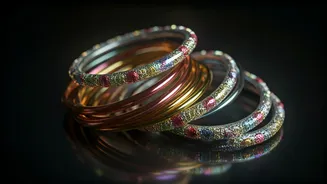
Glass bangles, once a staple yet often overlooked accessory in the Indian wardrobe, are experiencing a significant revival. Far from being a mere nostalgic
nod, these vibrant pieces are being actively recontextualized by contemporary designers, artists, and a fresh wave of consumers. We're seeing them adorning wrists at cultural events, styled by creators embracing bold 'desi maximalism,' and crafted with innovative designs by artisans for emerging fashion labels. Their presence is noted not only as favored wedding return gifts but also within curated multi-brand jewelry boutiques, signifying a deliberate shift from their prior status. This re-emergence is less about a simple comeback and more about a thoughtful evolution in perception and application, driven perhaps by a blend of fond memories and the ever-shifting tides of fashion trends.
Historical Roots & Craft
The lineage of glass bangles stretches back to the grandeur of Mughal eras, with specific locations like Firozabad in Uttar Pradesh establishing themselves as pivotal centers for their production. Despite a period where their visibility in mainstream fashion imagery might have diminished around the early 2000s, the local economies built around this craft continued to flourish. The artistry and skill involved in creating these bangles persisted, consistently meeting the demand for both daily adornment and pieces essential for festive occasions and significant ceremonies. This enduring legacy highlights the deep cultural integration and the resilient nature of this traditional handicraft, even as external fashion trends evolved.
Evolving Perceptions
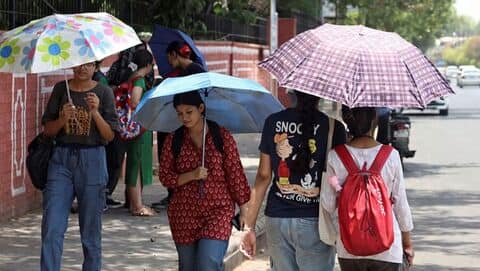
The journey of glass bangles away from widespread fashion favor wasn't uniform across all demographics. While segments of the middle and upper classes gradually shifted their preferences, women in working-class and non-urban communities continued to integrate these bangles into their daily lives, viewing them as integral to cultural expression rather than fleeting trends. Digital creator Rashi Sharma shared poignant memories of her mother's modest collection, noting how the bangles were intertwined with the rhythms of daily labor, their characteristic sound marking routines and their occasional breakage being an unremarkable part of everyday life, especially among domestic workers. This divergence reflects a broader pattern of aesthetic filtering prominent in the early 2000s, where globalized cultural influences led to a greater emphasis on international trends over distinct cultural expressions.
Creative Reimagining
Upon returning to India, a curator and label founder began to view glass bangles and traditional crafts through a renewed lens. Recognizing their inherent value, the focus shifted from downplaying their characteristics to thoughtfully reworking them for a broader, potentially international, audience. This involved a process of deconstruction and reinterpretation – altering proportions, simplifying elements, and experimenting with diverse color palettes. The aim was to create pieces that transcended simple categorization as either purely traditional or strictly modern, making them feel universally relevant. This approach, informed by experiences abroad, allowed for an understanding of how these reworked designs could resonate across different markets, demonstrating a keen awareness of global appeal.
Innovative Collaborations
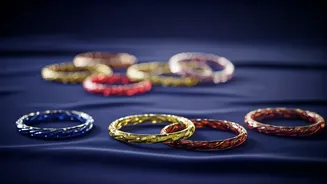
A homegrown accessory brand founder's engagement with the glassmakers of Firozabad stemmed from a deep curiosity and profound respect for their established craft. Through collaborative efforts with these skilled artisans, novel techniques were applied to the creation of glass bangles. Experiments included incorporating silver fuming, adjusting the thickness and texture of the glass, and exploring a wider spectrum of colors. The resulting collections, aptly named 'Dawn/Dusk' and 'Ebb/Flow,' subtly altered the common perception and experience of this familiar object. For instance, the 'Dawn/Dusk' bangles feature colors and reflective qualities that enhance their versatility, while the 'Ebb/Flow' bangles introduce suspended plasma, lending an element of dynamic playfulness and visual intrigue.
Styling for Today
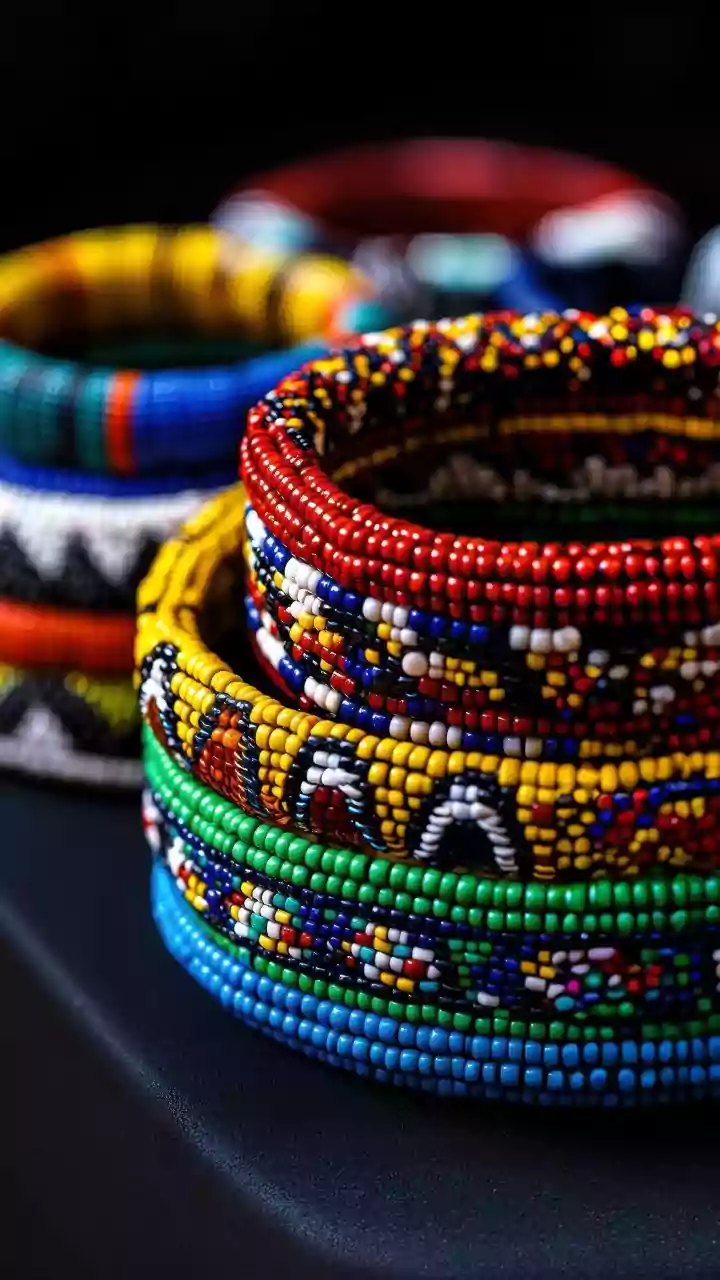
The current re-engagement with glass bangles is less about a historical revival and more about a fundamental shift in their styling and contextualization. For individuals like Rashi Sharma, who now frequently wears stacks of bangles, this represents a reclamation of a personal, familiar element. She observes a growing consumer inclination towards items that evoke comfort, familiarity, and a sense of rootedness in memory. Furthermore, she notes a contemporary shift on social media, moving away from overly polished presentations towards more authentic, personal narratives. Glass bangles, with their inherent imperfections, fragility, and emotional resonance, align perfectly with this evolving aesthetic. The focus is on wearing them intuitively, allowing their unique character – their sound, their fragility, their everyday presence – to coexist harmoniously within modern styling, rather than being forced or diluted.
A New Perspective
The significant evolution lies not in altering the physical form of the glass bangle itself, but in fundamentally changing the context in which it is presented and perceived. This shift signifies relevance over mere revival. It's about a generation more confident in expressing their identity without compromise, reinterpreting an object once confined to traditional attire. The renewed presence of these bangles is attributed to the inherent joy they bring, coupled with the developing, collaborative dynamic between artisans and designers. Ultimately, this movement signals not a simple resurgence, but a deliberate redefinition of how glass bangles are worn, styled, and made visible, all on contemporary terms.