







A Royal Drape's Origin
While Indian weddings often feature Kanjeevarams and Banarasis, a distinct and dignified tradition from Coorg is now gaining attention. This unique Kodava-style
wedding saree, famously associated with Rashmika Mandanna's rumored bridal choice, represents one of South India's most culturally rich and intricate bridal drapes. It's not just any saree; it's a legacy artfully worn with immense grace and precise technique. The appeal of this particular drape lies less in ostentatious embellishments and more in the meticulously executed draping method, making it stand out from other heavy, brocaded silk sarees that are popular for Indian weddings. The choice of such a heritage-rich attire by a prominent personality like Rashmika Mandanna signifies a connection to ancestral roots and a deliberate move away from conventional bridal fashion tropes, celebrating cultural identity.
Color Codes and Textiles
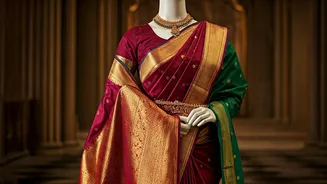
Kodava brides traditionally embrace a palette of deep, auspicious colors, predominantly featuring shades of rich red, vibrant saffron, and serene off-white or ivory. These sarees are typically crafted from pure silk, distinguished by their elegant gold zari borders. Despite their opulent appearance and the presence of heavy brocade work, these sarees are surprisingly lightweight. The true grandeur and visual impact of the Kodava bridal ensemble stem not from the fabric's weight or excessive ornamentation, but from the distinctive and skillful manner in which the saree is draped. This emphasis on the draping technique highlights a different facet of bridal elegance, one that prioritizes form and tradition over sheer material extravagance.
Jewelry Symbolism
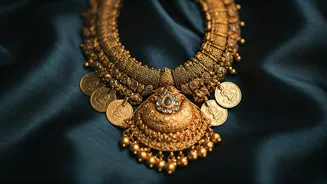
The accompanying jewelry for a Kodava bride is as distinctive and meaningful as the saree itself. Key pieces include the 'Pathak,' a layered gold necklace, and the 'Jomalae,' a coin necklace intended to symbolize prosperity and good fortune. Further enhancing the ensemble is the 'Kokkethathi,' a traditional waist belt that artfully cinches the saree, providing structure and accentuating the drape. Each piece of jewelry carries significant historical weight and is often passed down through generations, serving as a tangible link to family lineage. For the Kodava community, the bridal attire, including the jewelry, reinforces the profound message that a wedding is not merely about commencing a new chapter, but about honoring and perpetuating the continuity of the clan, its deep-rooted traditions, and its rich ancestral heritage.
Signature Drape Method
What sets the Kodava saree apart is its unique reverse pallu drape. Unlike the conventional Nivi style where the pallu typically flows from the wearer's left to right, the Kodava drape involves pleating the pallu at the back and then artfully bringing it forward over the right shoulder. This distinctive back-to-front draping is not solely for aesthetic appeal; it also serves as a powerful marker of identity and cultural belonging. The pleats are then meticulously secured at the back, often with a decorative pin, to create a structured and poised silhouette, further enhanced by traditional gold brooches. This methodical draping ensures both elegance and a sense of regal stability, embodying the spirit of the Kodava bride.
Kodava Bride Aesthetics
The Kodavas, a distinct cultural and linguistic community native to the Coorg region of Karnataka, are renowned for their robust customs and martial heritage. This inherent strength and grace are beautifully mirrored in their wedding attire. In contrast to many other South Indian saree styles, the Kodava saree drape boasts a remarkably practical aesthetic. This design facilitates ease of movement, allowing women to navigate the often hilly and uneven terrain of their homeland with comfort and freedom. Over time, this functional drape has evolved into a ceremonial masterpiece, worn with pride alongside treasured heirloom jewelry. A Kodava bride, therefore, doesn't merely wear a silk saree; she carries the weight and legacy of her entire ancestry draped elegantly upon her shoulders, symbolizing a profound connection to her past and community.