





A Penitential Pastime
The annual procession in Goa Velha, known locally as 'Santachem Pursanv,' is far more than a mere celebration; it's a solemn Lenten penitential practice
with deep historical roots. Parish priest Fr. Antonio Albuquerque emphasizes that its core purpose is reflection and penance, not festivity, correcting the common misconception of it being a 'feast.' This penitential character was established early in its history, which began between 1614 and 1617 in Pilar. Initially, the procession focused solely on the Veil of Veronica, a relic believed to have been brought from Rome by Franciscan Capuchins, the first religious order to arrive in Goa. Over time, particularly by the late 17th century, the procession expanded to include a vast array of saints, numbering 65, with the central theme always revolving around Jesus and his cross, serving as moral exemplars for the faithful.
Historical Twists and Turns
The tradition faced a significant disruption in 1835 when Queen Maria II of Portugal decreed the expulsion of religious orders, leading to the abandonment of the Pilar monastery. During this period of closure, many religious artifacts and vestments suffered neglect, vandalism, and destruction, a sorrowful account detailed by Rosario Rodrigues in his study. However, this rich heritage was not lost. The procession was revived in 1868, relocating to its current home at St. Andrew's Church in Goa Velha. This revival was spearheaded by Fr. Cyrilo de Anunciacao, who oversaw the transfer of all remaining assets from the Pilar monastery. Upon its re-establishment, the penitential procession featured approximately 25 tableaux, a testament to the enduring spirit of this unique Lenten observance that stands apart globally.
Diverse Saints, Deep Faith
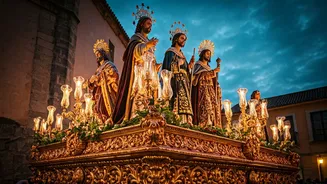
The procession, stretching almost 2 kilometers, showcases a diverse array of saints, including many lesser-known figures alongside popular ones. This includes individuals like Paschal Baylon, a Franciscan lay brother, Philip of Jesus, a martyr from Nagasaki, and Agnes of Assisi. Additions to the procession continued over the years, with St. Andrew, the village's patron saint, added in 1981, followed by 'Goencho Saib' St. Francis Xavier in 1984, St. Peter in 1985, and Goa's sole saint, St. Joseph Vaz, in 2009. Despite significant demand to include more recent figures like St. Mother Teresa and St. Carlo Acutis, the church's capacity limits further additions. The procession commences with Franciscan symbols, the Tau and Crossed Arms, and features St. Francis of Assisi himself as the initial figure. The life-size statues, some weighing up to 200kg, are meticulously numbered and named, carried by devotees who often walk beneath them seeking blessings, reflecting a profound and unwavering faith.
The Veil's Sacred Embrace
At the culmination of the procession, the Veil of Veronica holds a place of immense reverence. Believed to bear the divine imprint of Jesus's face, this ancient artifact is considered a sacred relic by devotees who vie for the opportunity to touch it. However, the preservation of this delicate relic is paramount, as explained by Fr. Albuquerque, who expresses concern about its potential damage. He has attempted to discourage the practice of people ducking under the statues to touch the veil, a tradition deeply ingrained in the community, with older members insisting it's an unshakeable part of their faith. Despite these efforts to protect the artifact, the overwhelming devotion and strong faith of the people underscore the profound spiritual significance of this ancient tradition in Goa Velha.