

Lost Himalayan Views
An extraordinary exhibition has opened in Delhi, presenting 77 historical images of the Himalayas, meticulously crafted nearly 170 years ago by German
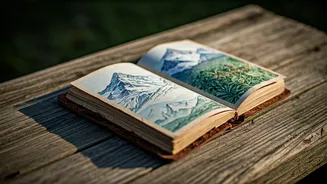
explorers, the Schlagintweit brothers. These rare artistic renderings, including early photographs and paintings, offer an unprecedented look into the colonial-era scientific surveys of what they termed 'high Asia.' For many in India, these visuals represent the very first public display of such detailed records, depicting landscapes, sacred temples, and remote regions that have significantly transformed over time. This collection satisfies a deep human curiosity about how our world, particularly stunning natural environments like the Himalayas, appeared in eras long past, serving as invaluable historical artifacts.
The Brothers' Quest
For well over a century, the artistic and photographic legacy of the Schlagintweit brothers and their extensive documentation of the Himalayas remained largely confined to European archives, libraries, and museum collections, known primarily to specialized mountaineering historians and scholars of Alpine studies. Now, for the first time, the people of India have an opportunity to publicly engage with a visual chronicle of the Himalayas as they existed almost 170 years ago, seen through the perspective of three German explorer siblings. The exhibition, provocatively titled 'Himalayan Encounters: Hidden Views from 170 Years Ago,' brings 77 remarkable images of the upper Himalayan region to Delhi. It provides a rare and intimate window into the colonial-era surveys undertaken by the brothers, who meticulously surveyed and documented what they referred to as 'high Asia.'
Pioneering Exploration Methods
The compelling artistic works featured in this exhibition owe their existence to a significant scientific endeavor commissioned in 1854 by the East India Company. The company enlisted three German geologists—Adolph, Hermann, and Robert Schlagintweit—to extend the magnetic survey of the vast Indian subcontinent. While the ambitious Great Trigonometrical Survey of India was already in progress, mapping large portions of the 'great arc,' the northern Himalayan expanses were still relatively uncharted territory. The brothers faced considerable geopolitical challenges, navigating permissions with various regions, as Kashmir granted access, Nepal delayed, and Sikkim outright refused. Himalayan historian Shekhar Pathak highlights a crucial innovation: the Schlagintweits were pioneers, being the first Europeans to utilize cameras in their surveys within India. Complementing their photographic efforts, they also produced exquisite paintings, often based on their very low-resolution photographic prints. Their comprehensive findings were later published in seven volumes, integrating detailed maps, precise measurements, and vivid visual records of the diverse landscapes they encountered.
A Treasure Returns Home
Among the 77 images presented in the Delhi exhibition, a significant portion, at least five, are being unveiled to the public for the very first time. These newly revealed views include a breathtaking panoramic perspective of Dal Lake in Srinagar, beautifully framed by majestic snow-capped mountains. Another notable piece captures the Bogapani Bridge, located in present-day Meghalaya, showcasing its unique construction on wooden stilts across a challenging, rugged hillside. The remainder of the collection artfully documents various aspects of the region, such as flowing rivers, serene temples, clusters of traditional houses, and the demanding high-altitude terrain. These images originate from a time when the overarching objective of the colonial administration was to meticulously map the entire globe, prioritizing even the most remote and inaccessible corners of the Himalayas. All the artworks on display are high-fidelity reproductions derived from the Schlagintweits’ original paintings and pioneering early photographs, which are part of a much larger collection of approximately 700 sketches depicting India and the vast expanse of 'high Asia.'
Exhibition Tour Details
The concept to bring these invaluable historical images back to India germinated in 2015. According to the exhibition's co-curator, Hermann Kreutzmann, the spark was ignited when Pathak visited an exhibition at the Alpines Museum in Munich. There, he discovered paintings depicting iconic locations such as Nainital, Badrinath, Kedarnath, Kanchenjunga, Ladakh, and various Tibetan monasteries. Pathak expressed his profound delight upon encountering this 'khazana' (treasure) of paintings, which immediately inspired a vision of exhibiting these works within India. The Schlagintweits' meticulous surveys and maps laid a crucial foundation for subsequent meteorological and geological research in the Himalayan region. Their extensive collections of rocks, minerals, plants, and ethnographic artifacts are now dispersed across numerous museums in Germany, England, and even Pakistan. This travelling exhibition will offer further opportunities to witness these historical visual records: after its Delhi debut, it will move to Dehradun’s Doon Library and Research Centre from May 1st to 9th, and subsequently to Nainital’s CRST Inter College from May 12th to 18th, providing audiences in the Himalayan region with an intimate connection to their own past.