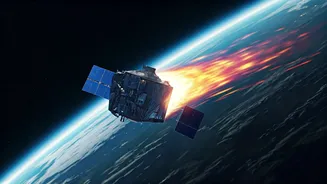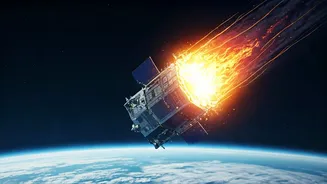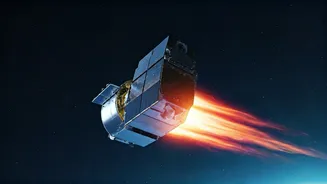





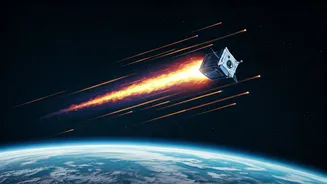
A Celestial Farewell
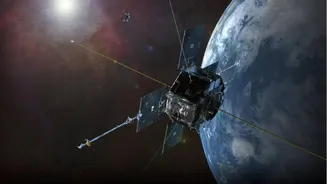
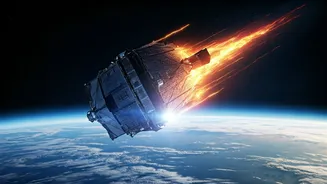
After an impressive 14-year journey orbiting our planet, NASA's Van Allen Probe A, a substantial spacecraft weighing approximately 1,323 pounds (600 kilograms),
was slated for a fiery return to Earth. Launched in August 2012 alongside its counterpart, Probe B, its primary mission was to delve into the complex radiation belts encircling our world. Although both probes were deactivated in 2019, Probe A's orbital tenure has now concluded, marking the end of its active service. The anticipated reentry date was set for March 10th, a significant event that science enthusiasts and the public alike had their eyes on, understanding that such descents are natural evolutions for aging spacecraft.
The Descent Dynamics
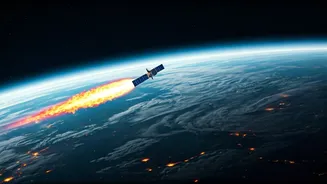
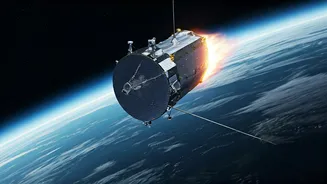
As Van Allen Probe A began its inevitable descent, the scientific community anticipated the event not just as an ending, but as a valuable opportunity for ongoing research. While most of the satellite was expected to disintegrate into a spectacular display of light as it plunged through Earth's atmosphere, experts noted that certain resilient components, particularly metallic parts and small electronic fragments, might survive the intense heat. These potential survivors were projected to land harmlessly in the vast oceans, significantly minimizing any risk to populations on land. The projected chance of any human injury from falling debris was estimated to be an extremely low 0.02%, a figure that experts emphasized was far less than many everyday risks, assuring the public that no drastic precautions were necessary.
Orbital Science Insights
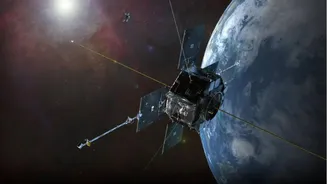
The Van Allen Probes, initially known as the Radiation Belt Storm Probes, embarked on a mission to explore Earth's magnetosphere. Their operational orbits were highly elliptical, taking them from approximately 384 miles (618 km) out to an astonishing 18,900 miles (30,415 km) from our planet. Originally intended for a mere two-year lifespan, both probes impressively surpassed their planned durations, with Probe A continuing its data collection until October 2019 and Probe B until July 2019. Recent solar activity is believed to have played a role in Probe A's earlier-than-expected orbital decay; increased solar activity can expand Earth's atmosphere, leading to greater frictional drag on satellites. This phenomenon is a critical area of study for maintaining the longevity and safety of other active satellites.
Legacy of Discovery
During their operational years, the Van Allen Probes were instrumental in gathering crucial data about the radiation belts surrounding Earth. This information is invaluable for scientists seeking to understand the complex interplay between solar activity and its terrestrial impacts. The data helps refine forecasts for space weather events, which can disrupt essential systems on Earth, including communication networks, GPS services, and even power grids. By studying these energetic particle regions, researchers have significantly improved our ability to predict and mitigate the hazards associated with solar storms, thereby contributing to the safety of astronauts and the reliability of our technology for future space missions.