

Individual Charm, Unified Frame
The days of mandatory matching wedding attire are fading, giving way to a more nuanced approach where both partners can express their unique styles without
sacrificing a cohesive appearance. Asymmetrical coordination is the key, allowing individuals to maintain their distinct aesthetic while still conveying a sense of togetherness. This method moves away from a singular, blended color scheme, instead emphasizing two prominent personalities contributing their individual energy to a shared celebration. It's a sophisticated, deliberate choice that results in a visually captivating and more engaging presentation of the couple, making them the focal points of their own beautifully framed moment.
The Shift from Uniformity
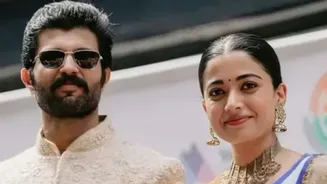
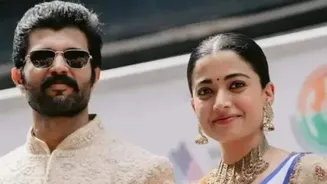
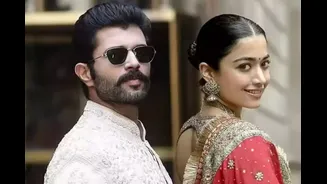
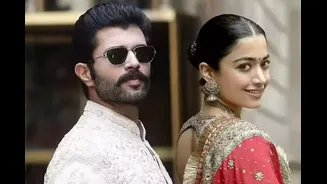
Historically, A-list weddings often adhered to an unspoken rule: complete wardrobe synchronicity. If one partner sported a particular pastel shade, the other's ensemble would be in the exact same hue. While this ensured a flawless, albeit predictable, photographic unity, it has increasingly felt like a sartorial obligation rather than a reflection of personal taste. The bridal fashion landscape is now evolving, embracing a vision where couples can authentically represent themselves as distinct individuals. The recent wedding ensembles of Vijay Deverakonda and Rashmika Mandanna serve as a prime example of this evolving trend, demonstrating that a couple can achieve a profound sense of unity without resorting to identical clothing choices.
The Future of Coordination
While matching outfits possess a timeless, nostalgic appeal, the emerging trend of subtle, asymmetrical coordination appears to be the definitive direction for wedding fashion. This approach not only results in beautiful photographs but also exudes an incredible sense of elegance. Crucially, it allows couples to avoid the appearance of wearing identical "team uniforms." For those currently in the midst of wedding planning and seeking to emulate this grounded, effortless aesthetic, the strategy is surprisingly straightforward. Modern couples can effectively implement asymmetrical coordination for upcoming celebrations by focusing on key styling principles.
Keys to Asymmetrical Style
To successfully achieve asymmetrical wedding coordination, couples can employ a few strategic techniques. The "Anchor and Accent" method suggests one partner should wear a bold, saturated color as the primary focal point. The other partner then builds their look around classic, neutral tones such as ivory, warm beige, or deep charcoal. The "Single Thread" principle emphasizes the power of one strategic accessory to harmoniously link both outfits. This could be a traditional safa (turban), a pocket square, or a woven shoulder stole that echoes your partner's dominant shade. Finally, prioritize "Texture Over Color." Instead of fixating on perfectly matched dyes, coordinate your fabrics. If one partner is in a heavy Kanjeevaram silk, the other might opt for a raw silk kurta or incorporate matching silk borders onto their dhoti. Sourcing high-quality, color-coordinated silk borders for a groom's neutral outfit is an economical styling trick, typically adding a manageable ₹3,000 to ₹7,000 to the tailoring budget.
Decoding Celebrity Style
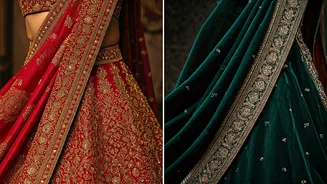
Examining the styling choices in celebrity wedding portraits offers valuable insights into the effectiveness of asymmetrical coordination. In the case of Rashmika Mandanna and Vijay Deverakonda, Rashmika commands immediate attention in a vibrant vermilion Kanjeevaram silk saree, its rich gold zari work and traditional drape naturally drawing the eye. Had they followed the outdated convention, Vijay might have worn a matching red sherwani, potentially diminishing the visual impact of both outfits. Instead, he grounded his look with a sharply tailored, crisp ivory dhoti. The crucial element that visually connected them was a single, impactful vermilion angavastram (shoulder drape), mirroring her aesthetic rather than replicating it. His neutral base outfit also allowed his intricate antique gold temple jewelry to stand out without competing with a vibrant fabric choice.