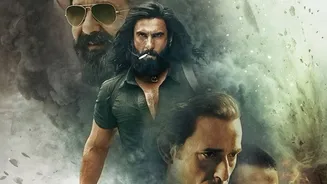









Ranveer Singh’s Dhurandhar released on December 5 and has already crossed Rs 200 crore in the domestic market. In just one week of its release, Dhurandhar has already managed
to take the third spot on the list of Ranveer's highest-earning films of all time. Bollywood has always had room for larger-than-life heroes, but the last few years have seen a seismic shift in how masculinity is packaged, sold and celebrated on the big screen. From Shahid Kapoor’s toxic yet wildly successful Kabir in 2019 film Kabir Singh to Ranbir Kapoor’s feral, blood-soaked Rannvijay in Animal and now Ranveer Singh’s ruthless RAW operative in Dhurandhar, the industry seems to be having a paradigm shift as it sees the resurgence of hypermasculine protagonists. These films are sparking national debates, breaking box office records and dividing audiences as they create dialogues. They are making big money. But what is driving this phenomenon? And more importantly, does hypermasculinity really sell in Bollywood, or is it one of its many trends?
The Return of the Angry Young Man
John Osborne birthed the Angry Young Man in his 1956 play Look Back In Anger and Amitabh Bachchan brought it to Bollywood in the 1970s. Sunny Deol utilised the persona in the 80s and 90s and even Shah Rukh Khan had an anti-hero phase in the nineties. But the new-age hypermasculine hero is different. He is less restrained, more unhinged, and often shockingly violent.
Also Read: Why Is Ranveer Singh's Dhurandhar BANNED In GCC - Bahrain, Kuwait, Oman, Qatar, Saudi Arabia And The UAE?
Kabir Singh (2019): Is He The Blueprint Of The Modern Anti-Hero Blockbuster?
Sandeep Reddy Vanga's Kabir Singh, with Shahid Kapoor in the lead, is arguably the watershed moment in Indian cinema. Despite a huge backlash for glorifying misogyny, emotional abuse, gaslighting and self-destruction, the film earned over RS 380 crore worldwide, becoming the biggest grosser for Shahid Kapoor. The character's recklessness, entitlement and explosive temper were precisely what drew audiences in. Kabir was not likeable, but he was undeniable. The film cracked the code: controversy sells, and flawed men sell even more.
Animal (2023): When Hypermasculinity Goes Full Throttle
If you thought Kabir Singh was provocative, Animal was volcanic. Sandeep Reddy Vanga pushed hypermasculinity to its extreme. Ranbir Kapoor’s Rannvijay was brutal, obsessive, unpredictable - and in many cases, horrifying. And yet, the film became one of the highest grossers in Bollywood history. Animal had a worldwide box office collection of over Rs 915 crore. No matter the criticism - misogyny, violence, glorification of toxic relationships - the box office numbers sang a different story. With Ranbir Kapoor’s Animal, Bollywood learned that the audience had an appetite for aggression and violence.
Also Read: Before Dhurandhar, THESE 7 Films Were BANNED In Gulf Countries
Dhurandhar (2025): The Patriotic Alpha Male
Aditya Dhar’s Dhurandhar, with Ranveer Singh in the lead, may be an espionage drama rather than a romance or family saga, but at its core, it too has a hypermasculine protagonist shaped by trauma, nationalism, and personal vendetta. The film has stormed the domestic box office, proving once again that the audience is ready to embrace a hero who punches first, speaks later. Even though the film has been banned across six Gulf countries, Dhurandhar is on track to become Singh's highest grosser, solidifying this trend. The film has crossed Rs 218 crore at the box office.
Why Hypermasculinity Works in Today’s Bollywood
India’s socio-political climate has grown more polarised. Audiences are hungry for stories of power - men who reclaim control in chaotic worlds. Hypermasculine heroes offer escapism in the form of dominance, strength and rebellion. And in a world already divided in its reality, these films tend to ignite a social fervour that turns into a trend.
Furthermore, it also gives rise of ‘alpha content’ on OTT. Global OTT trends - think Vikings, Peaky Blinders, Breaking Bad - have sharpened appetite teeth for flawed, dark, morally ambiguous male leads. Bollywood is simply keeping up with the trend.
What also works is the realism these heroes bring in. They are not invincible cardboard cutouts anymore, but rather wounded, emotionally damaged, and tormented souls. Their violence is framed as a response to trauma. This not only makes them accessible to viewers who may not share their aggression, but understand their pain, but also resonate across an audience belt who themselves are sufferers, raring to go.
Furthermore, post-pandemic cinema has shown that audiences crave theatrical experiences - mass moments, chest-thumping music, and alpha-centric energy. Hypermasculine characters are built for these environments - they explode larger than life.
But Is Hypermasculinity Sustainable? Or a Bubble Waiting to Burst?
To be honest, even though hypermasculinity is selling now, but Bollywood trends are cyclical. For every Kabir Singh, there’s a Gully Boy. For every Animal, there’s a 3 Idiots. Audiences are fickle, they evolve faster than the industry realises. And in many ways audience fatigue is real as well. After Animal’s intense emotional and visual brutality, a sections of viewers did express exhaustion.
Also Read: Why Dhurandhar Actor Ranveer Singh's Debut Film Band Baaja Baaraat Remains Bollywood’s Most Authentic Work-Life-Romance Story
Is Bollywood Narrowing Its Own Horizons?
When every hero is angry, violent and emotionally unstable, the industry risks becoming one note and cinema thrives on diversity. Even the wheels of cinema are turning and trends may soon swing back again. For every Dhurandhar doing well, a romantic Saiyaara has also left its mark.
Box Office Reality: Hypermasculinity Sells - But Balanced
If we look at it closely, Kabir Singh sold because of raw emotion, heartbreak and music and Animal sold because of father-son conflict more than the violence. And finally Dhurandhar is selling because of patriotism and high-octane action, not just aggression. In other words, what truly sells is emotion, wrapped in hypermasculinity - not hypermasculinity alone.
To be honest, audiences are not drawn to angry men, but rather they are drawn to complicated men, and hypermasculinity is just the cinematic vehicle that makes them larger than life.