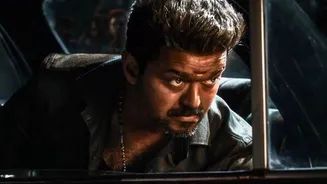







Trouble keeps mounting for Thalapathy Vijay’s Jana Nayagan. In the latest development, Madras High Court has reserved verdict on CBFC appeal against direction
to certify the Vijay Starrer film. But the verdict has also opened up a Pandora’s box of sorts. Cinema and censorhip in India have always shared a tense and uneasy relationship – one that continues to resurface times when politically charged or socially uncomfortable films run into trouble. The narrative around Vijay’s Jana Nayagan has only added fuel to the long-simmering debate. The question not only centres on what happens to this particular film’s fate, but around whether India’s censorship framework is increasingly at odds with the kind of stories contemporary filmmakers want to tell.
Vijay’s Jana Nayagan and the Politics of Perception
One of the biggest issues with Vijay’s Jana Nayagan was the fact that no one really knows what went wrong between the makers and the certification board. The film, which was originally slated for release on January 9, was withheld due to issues at the High Court. Reports suggest that throughout the certification process, few scenes, conversations and dialogues in the film lead to issues, which in turn, spun into a dispute between makers and CBFC. While the exact nature of the complaints were never disclosed, they reignited debate around creative freedom and the benchmarks used for certification in mainstream cinema.
However, what is true is that Jana Nayagan has been mostly perceived as a politically resonant film, made more sensitive by Vijay’s own evolving public persona and aspirations as he enters the political fray. Even before audiences could see the frame, the film entered a familiar danger zone - where cinema, mass influence, and political interpretation collided. Having said that it is not new territory for Tamil cinema, or for Vijay. Stars with immense public following often find their films micro-scrutinised not merely for content but also for the potential impact they might have on social narrative. When the title of the film itself translates to ‘people’s leader’, certification inevitably becomes about interpretations rather than just regulation. The intent is suddenly debated as fiercely as is the imagery and creative expression can feel pre-emptively curtailed.
The CBFC Question: Certification or Control?
India’s Central Board of Film Certification (CBFC) is officially tasked with certifying films, not censoring them and the Jana Nayagan situation has revived criticism. Is the film being evaluated purely on content, or on perceived political messaging? And more importantly, should cinema be diluted its voice to avoid discomfort? However, on a broader note, these questions resonate far beyond Tamil cinema, echoing across industries and languages.
The Dhadak 2 Factor
Consider what happened to Dhadak 2. The Siddhant Chaturvedi and Triptii Dimri film reportedly faced prolonged certification delays due to its narrative woven around caste dynamics. Even without explicit political commentary, films dealing with entrenched social hierarchies often face intense scrutiny. Sometimes, stories that reflect lived realities are the ones deemed “too sensitive” for public viewing.
In Dhadak 2’s case, the hesitation seemed less about visuals and more about conversations.
Phule and how History Isn’t Always Comfortable
Phule too is an example, perhaps. By revisiting the legacy of social reformers Jyotirao and Savitribai Phule, the film stepped into ideological territory that remains politically charged even today. The CBFC asked filmmakers to remove an/or modify several scenes and terms, after it faced objections from certain Brahmin organisations in Maharashtra. Objections and requested cuts led to Phule's release delay from April 11, 2025, to April 25 of the same year.
Santosh and Certification Woes
Take for instance Santosh - a quieter, intimate film. The 2024 police procedural crime drama by Sandhya Suri reportedly ran into issues despite its restrained storytelling. Films like Santosh underline how censorship isn’t only about spectacle or controversy. Sometimes, it’s about the artistic tone. Perhaps it is about a refusal to simplify complex realities and provide moral resolutions that are easy. And sometimes, unwittingly, certification hurdles feel less like regulation and more like resistance.
Jana Nayagan and Others
Viewed together, Jana Nayagan, Dhadak 2, Phule and Santosh perhaps hint at a pattern rather than isolated incidents. Films that questioned traditional societal motifs are increasingly finding themselves entangled in certification battles. And what is striking is that this trend cuts across scale and stardom. Whether it’s a pan-India star vehicle or a modest indie film, the friction remains the same. The problem is discomfort.
Audiences have Changed, BUT
In many ways the Indian audience has evolved. They are more exposed, informed and ready to engage in complex narratives. However, certification frameworks often appear rooted in an older logic - one that assumes audiences need shielding rather than context. However, excessive caution ends up in shaping the industry’s creative direction. For stars like Vijay, whose influence is much more than restricted to the screen, stakes are even higher. Jana Nayagan’s certification woes highlight how political reading can overshadow artistic intent and in a way turning cinema into a battleground before it even reaches audiences.
So, does Jana Nayagan restart the cinema and censorship debate? Well, in all honesty, perhaps the debate never ended.