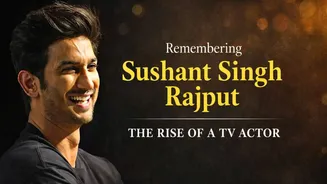

Sushant Singh Rajput died in 2020, and yet, he never died. Perhaps no actor has been kept alive in collective conscience as vehemently as the Pavitra Rishta
star who successfully crossed over from the idiot box to the silver screen. In the glittering halls of Bollywood, where success stories are often pre-destined – stars born into stardom, groomed by legacy and cushioned by access, Sushant rise to fame stands out not just because he was an abject outsider, but also because he emerged from television, a space that Hindi cinema has historically looked down upon. A career birthed in the halls of daily soaps, Sushant’s journey took him to the big screen – in an adventure that was a quiet rebellion against entrenched hierarchies. And perhaps precisely that is why Sushant Singh Rajput’s rise will always be special.
TV was the starting line, not the destination
Contrary to what many think Ektaa Kapoor actually gave Sushant his first break in Kis Desh Mein Hai Meraa Dil. However, Sushant's Manav in the 2009 Pavitra Rishta is what would cement him in the hearts of millions worldwide for, perhaps, eternity - a role that could possibly have never gone to him at all. When Sushant entered the world of Indian television in the mid-2000s, the medium was booming, but there was a clear decisive line between TV and cinema. TV actors had become increasingly popular, commanding fan loyalty across households. And yet, they were rarely taken seriously by the film industry. There was a seemingly unspoken – television fame was loud, but limited. A ‘TV star’ was destined to be just that – crossing over to films – especially as a leading man – was unheard of.
What followed Sushant’s metamorphosis into Manav was not overnight superstardom. But the seeds of a rebellion had already been sown and a slow, organic build of trust between actor and audience was birthed. What worked for Manav and as an extension Sushant was that the character was not flashy. Unlike contemporary prime time soaps which gazed into the lives of millionaire families and their complex dynamics and intrigues, Manav as sincere, restrained and emotionally grounded. He was a working-class mechanic whose integrity mattered more than grand gestures. Sushant’s performance resonated deeply with the middle-class viewer who saw in him a reflection of everyday decency – and struggles – in life, love and life all over again. Within months Sushant had become one of the most loved faces on Indian television.
Sushant’s fame came without complacency
What made Sushant so different from contemporary successful television actors was his relentless pursuit of success. Pavitra Rishta could have been a comfortable long-term gig – financially secure, emotionally familiar and immensely popular – and for many, it could have been the end goal. But for Sushant, it was a stepping stone.
Even when Sushant was thriving as Manav on television, he was perhaps acutely aware of his limitations. He was always vocal about wanting to transition to cinema, about films being the dream he was ultimately chasing. His goals were clear, but that clarity came at a cost. Leaving a hit TV show meant risking relevance, income, and fan goodwill. It also meant stepping into a film industry that rarely welcomed television actors with open arms.
Yet, not shockingly in retrospective, perhaps, Sushant chose uncertainty over stagnation. When he quit Pavitra Rishta in 2011, the decision was met with disbelief and criticism. Many believed he was walking away from guaranteed success for a near-impossible dream. That decision would define the courage behind his rise.
Actor’s mindset and Sushant Singh Rajput
Sushant Singh Rajput never treated television as a shortcut to fame. Sushant treated acting as a craft. His background in theatre -training under Barry John - gave him a strong foundation in performance, discipline, and character work. This grounding was evident even in his TV performances, where his body language and emotional control stood out in a melodrama-heavy space. Perhaps, in hindsight, for Sushant, television was not about shortcuts; it was about preparation.
That mind-set would become crucial when he made the leap to cinema.
Breaking the ‘TV actor’ ceiling
When Sushant Singh Rajput finally debuted in Bollywood with the 2013 Kai Po Che! it was significant not just for him, but for the perception of television actors at large. An adaptation of Chetan Bhagat’s novel, the film – very smartly - did not position him as a conventional hero. Instead, it allowed Sushant to be vulnerable, volatile, and flawed. And Critics took note.
As for the audiences, they responded. But most importantly, the industry began to perceive him differently. He was no longer “a TV actor trying films.” He was an actor with certainty.
But the shift did not happen overnight. Sushant had to constantly prove that his talent. Each subsequent choice - Shuddh Desi Romance, Detective Byomkesh Bakshy!, Sonchiriya – all felt like an attempt to dismantle preconceptions about him - brick by brick.
Carrying the weight of representation
For aspiring television actors,Sushant’s journey has become symbolic. He represented hope and the possibility to be taken seriously, to escape typecasting and to command leading roles without a lineage steeped in cinema history. Sushant Singh Rajput’s success was not just personal, it was collective.
However, this symbolic weight also came with pressure. Unlike star kids, Sushant could not afford failure. Each underperforming film was seen as confirmation of industry bias against outsiders, particularly those who had travailed from TV. His rise - never smooth – as it came under constant scrutiny, questions and tangible measurements.
And yet, Sushant Singh Rajput persisted.
Sushant’s validation through MS Dhoni
If Kai Po Che! had announced the arrival of a TV actor in cinema, MS Dhoni: The Untold Story (2016) cemented Sushant’s legitimacy. Playing one of India’s most revered sports icons was a monumental responsibility, and Sushant approached it with characteristic discipline. The film’s success was transformative. For the first time, a former television actor had delivered a massive Bollywood blockbuster as a solo lead. This symbolism would go on to prove to be extremely powerful. Much like Dhoni himself, Sushant’s journey - from small beginnings to national recognition - felt earned, grounded, and inspirational. MS Dhoni shattered long-held industry biases.
Sushant Singh Rajput’s rise was rooted in authenticity
In hindsight, what made Sushant Singh Rajput’s rise truly special was its authenticity. His was not a carefully curated persona, there was no manufactured mystique. Sushant’s realism stemmed from the fact that he openly spoke about failure, ambition, mental health, and curiosity. And he discussed science and philosophy with equal ease, challenging the pre-defined definitions of stardom. And his social media presence reflected this honesty – which was surprisingly innocent, engaging, thoughtful, and often vulnerable. Fans admire him, yes, but more than that, they related to him – seeing in him an extension of their own struggles reflected in his journey from TV to films.
But Sushant’s remained an unfinished journey
French philosopher Jacques Derrida in his theory of deconstruction often spoke about 'iterability' which hinted on a book living on, beyond the initial moment of writing, independent of the author. In many ways, Sushant’s life remains that tome which continues to create conversations. Sushant Singh Rajput’s untimely death in 2020 cast a long shadow over his career, but it also sharpened focus on what he had achieved in a short span. Today, when TV actors dream of cinema, Sushant’s name comes up, not as an exception, but a benchmark.
The rise of Sushant Singh Rajput will always be special. The Patna boy challenged power, redefined ambition and proved that talent can travel – when presented with opportunity. From television to cinema, Sushant Singh Rajput’s did not just rise, but carved a path in stone. And in doing so, left behind a legacy that continues to inspire.