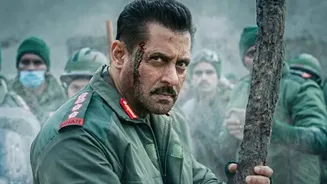

Salman Khan released the first look teaser of Battle of Galwan on his birthday, December 27. The film is said to be based on the 2020 clashes between Indian
and Chinese soldiers in the Galwan region of Ladakh, India. While Salman has joined the bandwagon of the current league of war movies, the teaser received mostly positive reactions from fans in what they claim as one of his most restrained and commanding roles by the 60-year-old actor. While Salman's global fandom is waiting for the release on April 17, 2026, fans on the Chinese side are a tad disappointed. Infact, many allege the film distorts history, true facts, and account of events that occured on the battlefield. Salman, who acquired a huge fanbase in China post Bajrangi Bhaijaan (2015), seems to have left them questioning post the release of Battle of Galwan teaser. Many have been posting their dismay on social media, especilly Weibo where they've slammed the narrative of the film.
What is Battle of Galwan about?
Battle of Galwan is said to be inspired by the 2020 India‑China clash in the Galwan Valley. According to the makers, it depicts the Indian Army's 16 Bihar Regiment led by Colonel B. Santosh Babu, that engaged in a combat with Chinese soldiers and pays tribute to the bravery of Indian troops who died in the intense military action. Directed by Apoorva Lakhia, the film has Salman Khan playing the character of Colonel B. Santosh Babu.
Chinese fans are not happy with the 'narrative'
Many Chinese fans reacted to the teaser. According to Global Times, a Weibo user under the handle 'Qingning Riyue v' called out Battle of Galwan, alleging that the film contradicts the facts. Another Weibo user under the name of 'Situka 98' wrote, "When history falls short, Bollywood steps in."
Citing Chinese military expert Song Zhongping, the Global Times claimed that "India's use of films, especially Bollywood productions, to stir nationalistic sentiment is unsurprising, reflecting a deeply rooted cultural and political tradition." An excerpt from Song's allegations in the report reads, "No matter how films dramatize or embellish events, they cannot change the core facts of the Galwan Valley incident: India crossed the border first, and the PLA defended China's territory in accordance with the law." Song added, "No matter how 'over-the-top' a drama may be, a nation's sacred territory will never be affected by a film."
Battle of Galwan's timing inappropriate?
The report also pointed at the timing of Battle of Galwan. Lan Jianxue, director of the Department of Asia-Pacific Studies at the China Institute of International Studies slammed its "one-sided Indian narrative" alleging that it "stokes antagonistic sentiment" at a time when the bilateral relations between the two nations seem to be improving.