
Sivakarthikeyan, Ravi Mohan and Sreeleela’s recently released Parasakthi has been trending for the past week. Tamil Nadu Youth Congress demanded a ban
on the Sudha Kongara film, claiming that the makers deliberately misrepresented historical events and defamed the Indian National Congress and its leaders. The political drama is inspired by the anti-Hindi agitations in Tamil Nadu in 1965. According to the Youth Congress, Parasakthi spreads misinformation and intends to change the party's legacy. The political party further felt that such portrayals go beyond creative freedom. The organisation has demanded a ban on the film, removal of the scenes, and a public apology from the filmmakers.
Parasakthi real story explained
Parasakthi is about a former student participating in the 1965 Anti-Hindi imposition agitation in Tamil Nadu. The agitation started as early as 1938 when an order made Hindi compulsory in many schools in the Madras Presidency. Periyar E. V. Ramasamy and the Justice Party (later Dravidar Kazhagam, DK) initiated protests to resist the order.
What was anti-Hindi protests all about?
The anti-Hindi protests continued from 1946 to 1950 and at that time, they focused on opposing compulsory Hindi in schools. The government made Hindi optional rather than mandatory by 1950. When the Government of India planned to make Hindi the sole official language after the transitional period ended, massive protests erupted across Tamil Nadu among students and political organisations. The violent agitation reported deaths, self-immolations, and intense confrontations.
Amid the violent protests, the then Prime Minister Lal Bahadur Shastri agreed allow English to continue indefinitely alongside Hindi as an associate official language. Tamil Nadu, a cultural hotspot, allegedly saw Hindi as a threat to Tamil culture and heritage.
Political angle
As per reports, the anti-Hindi movement benefited Dravida Munnetra Kazhagam (DMK) after the party prominently stood up against the order. It came to power during the 1967 elections. After rejecting Hindi, Tamil Nadu adopted a Two-Language Policy (Tamil and English). Even today, the impact of the anti-Hindi movement can be felt. The state remains sensitive to the three-language policy under the newer education reforms.
How did Indira Gandhi contribute?
After Lal Bahadur Shastri’s death, under Indira Gandhi’s leadership in 1967, the Official Languages Act (originally passed in 1963) was amended by the Union government to guarantee the indefinite use of both Hindi and English as official languages of the Union of India. This meant that English would not be replaced by Hindi alone, and it could continue indefinitely in official communication and administration, effectively satisfying one of the major demands of the Tamil Nadu agitators.
While Indira Gandhi did not have any active involvement in the anti-Hindi protests, she played an important role in protecting English and Hindi.
What is Parasakthi?
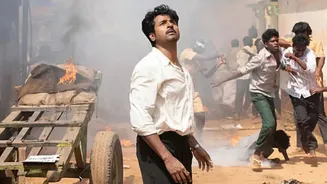
Parasakthi is about Chezhiyan (Sivakarthikeyan), a railway fireman leading a peaceful life while striving to educate his younger brother, Chinna (Atharvaa Murali). However, his faith is shaken when he discovers Chinna actively protesting against language imposition. Fearing for his brother’s well-being, he restricts him from organising student protests against the government.
Meanwhile, Chezhiyan travels to Delhi to attend an interview for a TTR post, only to be rejected due to his poor Hindi fluency. Soon after, he witnesses a tragic incident in which a student takes his own life following new language and educational laws. This incident reignites Chezhiyan’s suppressed rage and reveals his past as a student leader who once led Operation Purananooru.
Parasakthi also stars Dev Ramnath, Prithvi Rajan, Guru Somasundaram and Basil Joseph.