





What's Happening?
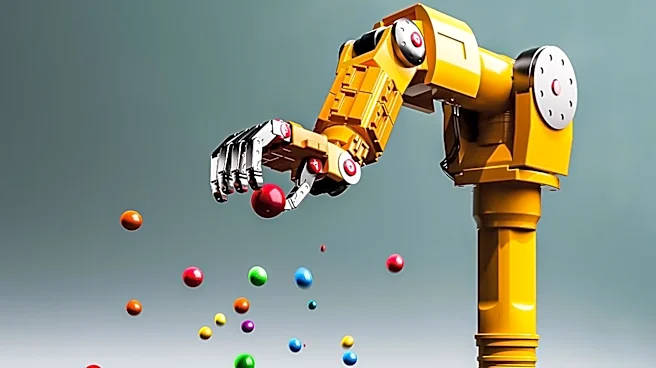
Generalist has announced that its latest embodied foundation model, GEN-1, now supports a wide range of robot end effectors. This development allows GEN-1 to be compatible with various tools, from five-fingered hands to specialized equipment, enhancing
its ability to learn sensorimotor policies across different physical interactions. The model is trained on a comprehensive dataset that includes over half a million hours of real interaction data, covering approximately 9,000 variations of end effectors. This training enables GEN-1 to adapt to new tools and actuation strategies, promoting a universal sensorimotor understanding that can transfer across different robotic hands.
Why It's Important?
The expansion of GEN-1's capabilities signifies a major advancement in robotics, particularly in the development of general physical intelligence. By supporting a diverse array of end effectors, GEN-1 can facilitate more versatile and efficient robotic applications across various industries. This adaptability is crucial for tasks that require different tools and strategies, potentially reducing the need for multiple specialized robots. The ability to switch between end effectors seamlessly could lead to more cost-effective and flexible automation solutions, benefiting sectors such as manufacturing, logistics, and healthcare.
What's Next?
Generalist plans to continue expanding its dataset and refining GEN-1's capabilities to further enhance its adaptability to new tools. The company is also studying how different end effectors influence the model's learning process, aiming to optimize its training strategies. As GEN-1's capabilities grow, it is expected to play a significant role in the evolution of robotics, potentially leading to more sophisticated and autonomous robotic systems that can perform complex tasks in dynamic environments.