








What's Happening?
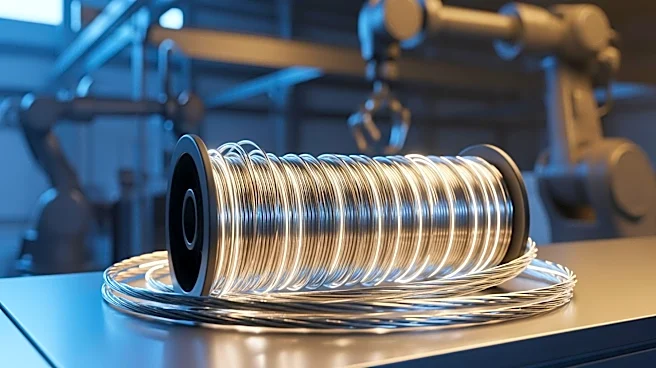
The global market for flux-cored arc wire is projected to experience significant growth through 2035, with a compound annual growth rate (CAGR) of approximately 4.6% from a 2025 baseline. This growth is largely driven by increased investments in industrial
welding automation, particularly in the Asia-Pacific and North American regions. These areas are seeing accelerated projects in heavy equipment fabrication, shipbuilding, and energy infrastructure. Gas-shielded flux-cored arc welding (FCAW) grades dominate the market, accounting for 70-80% of global tonnage, while self-shielded variants are gaining popularity in field construction and repair due to their wind tolerance and portability. Key producers such as Lincoln Electric, ESAB, ITW, Kobe Steel, and Hyundai Welding supply about half of the global output. The market is influenced by factors such as raw material cost volatility and trade policy fragmentation.
Why It's Important?
The expansion of the flux-cored arc wire market is crucial for several industries, including shipbuilding, heavy equipment manufacturing, and energy infrastructure. The adoption of automated welding systems is expected to enhance productivity and efficiency, reducing the reliance on manual labor and improving weld quality. This growth supports the broader industrial shift towards automation and digitalization, which can lead to cost savings and increased competitiveness for manufacturers. Additionally, the demand for premium, low-spatter FCAW formulations is likely to rise, driven by the need for high-quality welds in automated applications. The market's growth also reflects the ongoing global push for infrastructure development and renewable energy projects, which are critical for economic growth and sustainability.
What's Next?
The market is expected to continue its growth trajectory, with demand increasingly tied to capital expenditure cycles in heavy manufacturing, renewable energy, and infrastructure renewal. Automation and productivity gains will drive the preference for premium FCAW formulations. However, potential risks include trade tariffs, energy cost spikes, and slower-than-expected automation adoption in smaller fabrication shops. The market will likely see increased use of robotic and automated welding systems, particularly in regions with strong infrastructure and energy project pipelines. The ongoing replacement of manual welding with semi-automatic and robotic systems will further support market growth.