





What's Happening?
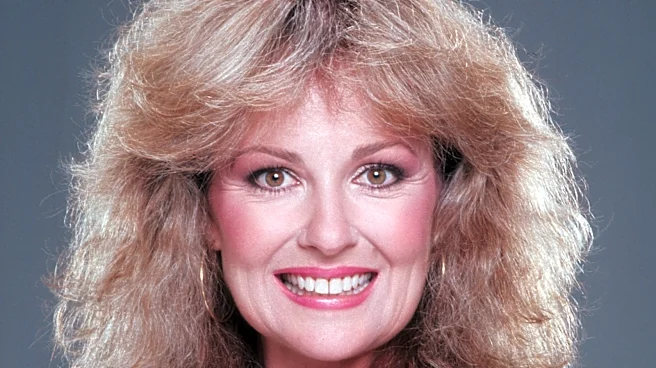
Shelley Fabares, a prominent actress and singer known for her roles in 'The Donna Reed Show,' 'One Day at a Time,' and 'Coach,' has passed away at the age of 82. Her family confirmed that she died on Saturday in Los Angeles, though no specific cause of death
was provided. Fabares began her acting career as a child, making her television debut at age 10 on 'The Loretta Young Show.' She gained significant recognition as Mary Stone on 'The Donna Reed Show,' a role she held from 1958 to 1963. During this period, she also launched a singing career, achieving two Top 40 hits, including the popular song 'Johnny Angel.' Her film credits include co-starring in three movies with Elvis Presley: 'Girl Happy,' 'Spinout,' and 'Clambake.' Later in her career, she was known for her portrayal of Francine Webster in 'One Day at a Time' and Christine Armstrong in 'Coach.' Fabares was also a dedicated advocate for Alzheimer's awareness, a cause close to her heart due to her mother's battle with the disease. In 2000, she underwent a liver transplant after being diagnosed with progressive liver failure.
Why It's Important?
Shelley Fabares' passing marks the end of an era for a beloved figure who graced American television and film for decades. Her career, spanning from the golden age of television to more contemporary sitcoms, showcased her versatility and enduring appeal. Her role as Mary Stone on 'The Donna Reed Show' made her a household name and an iconic figure for a generation of viewers, embodying the wholesome family values often depicted in 1950s and 60s programming. Her musical success with 'Johnny Angel' further cemented her status as a multi-talented entertainer. Later roles in 'One Day at a Time' and 'Coach' demonstrated her ability to adapt to evolving television landscapes and maintain relevance with new audiences. Beyond her professional achievements, Fabares' advocacy for Alzheimer's awareness highlighted her commitment to social causes, using her platform to bring attention to a critical health issue. Her personal battle with liver failure and subsequent transplant also brought public attention to organ donation and the challenges faced by those awaiting life-saving procedures, potentially inspiring others and raising awareness for medical advancements.
What's Next?
While no specific public memorials or tributes have been announced, it is anticipated that the entertainment industry and her fan base will honor Shelley Fabares' legacy in the coming days and weeks. Tributes from former co-stars, colleagues, and fans are expected to emerge, reflecting on her contributions to film and television. Media outlets will likely continue to publish retrospectives of her extensive career, highlighting her most memorable roles and musical achievements. Her work in advocating for Alzheimer's awareness may also see renewed attention, potentially inspiring further support for research and patient care in her memory. The impact of her passing will likely be felt across various generations of viewers who grew up watching her on screen, solidifying her place as a significant figure in American popular culture.
Beyond the Headlines
Shelley Fabares' career trajectory offers a compelling look at the evolution of the entertainment industry over several decades. Starting as a child actor in the 1950s, she navigated the transition from classic television to more modern formats, demonstrating remarkable longevity and adaptability. Her experience on 'The Donna Reed Show' provides insight into the cultural norms and family dynamics portrayed in post-war America, while her later roles reflected changing societal views and comedic styles. Her dual success as an actress and singer also highlights a period when entertainers often crossed over between different mediums, a practice that has evolved significantly in contemporary show business. Furthermore, her personal health struggles and subsequent advocacy underscore the human element behind public figures, revealing how personal challenges can be transformed into platforms for public good. Her dedication to Alzheimer's awareness, stemming from a personal connection, exemplifies the powerful role celebrities can play in destigmatizing diseases and mobilizing support for critical causes, leaving a legacy that extends beyond her artistic contributions.