






What's Happening?
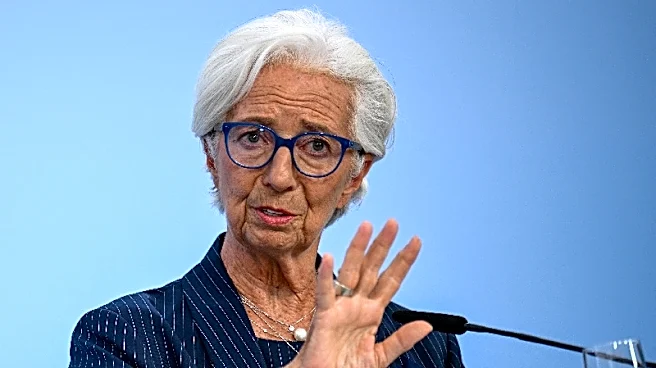
Christine Lagarde, President of the European Central Bank (ECB), has pointed out that European savings are significantly funding the expansion of artificial intelligence in the United States. Eurozone households hold approximately €440 billion in U.S.
technology companies, including major players like Nvidia and Alphabet. Lagarde, speaking in Vienna, warned that this trend means European savings are contributing to the U.S. AI boom without Europe receiving a comparable share of the economic benefits. She noted that in the past year, the United States produced 59 notable AI models, and China produced 35, while France and the United Kingdom each produced only one. This disparity highlights a challenge for Europe, which, despite not lacking capital, struggles to channel funds into its own growing companies. Eurozone households hold nearly €10 trillion in bank deposits, with a significant portion of their financial assets in deposits compared to U.S. households, and a large majority own no shares, bonds, or investment funds.
Why It's Important?
This situation is important for the U.S. as it underscores the significant foreign capital inflow supporting its technology sector, particularly in AI. European investment provides a substantial financial boost to U.S. AI companies, enabling further innovation and expansion. For the U.S., this influx of capital helps maintain its leadership in AI development and strengthens its economic position in the global technology landscape. However, it also raises questions about the sustainability of such reliance on foreign capital and potential geopolitical implications if European nations decide to redirect these investments domestically. The continued flow of European funds into U.S. tech could also influence global interest rates, as major U.S. hyperscalers' bond issuances contribute to higher global yields, impacting borrowing costs in the eurozone. This dynamic benefits U.S. companies by providing accessible and often cheaper capital for their ambitious investment plans in AI infrastructure.
What's Next?
The ECB's analysis suggests that major U.S. hyperscalers are projected to spend over $1 trillion (€870 billion) on capital investment by 2028, covering data centers, advanced chips, and network infrastructure. Last year, these companies issued more than $100 billion (€87 billion) in bonds, accounting for nearly one-tenth of new euro-denominated bond issuance by non-financial companies. European funds, insurers, and pension schemes are directly lending money to these American technology companies by purchasing these bonds. In response to this trend, the EU is working on initiatives like the Savings and Investments Union and the Listing Act to make it easier for European households to invest domestically and for European companies to access funding. These reforms aim to foster a more robust European tech ecosystem, potentially leading to a redirection of some European capital towards homegrown companies in the future, though the success of these measures remains to be seen.
Beyond the Headlines
The deeper implication of European savings financing the U.S. AI boom lies in the structural differences between the European and U.S. investment landscapes. Europe possesses ample capital, but a significant portion remains in bank deposits or property, with limited direct investment in financial markets. This contrasts sharply with U.S. households, which have a higher propensity for stock and bond ownership. The challenge for Europe is not a lack of money but rather a difficulty in channeling these funds into high-growth, innovative companies, particularly in the tech sector. This disparity highlights the need for deeper venture capital markets, a greater willingness to finance higher-risk businesses, and regulatory frameworks that support innovation. Without these changes, Europe risks falling further behind in critical technological advancements like AI, potentially impacting its long-term economic competitiveness and strategic autonomy in the global tech arena.