






What's Happening?
Mafix, a California-based startup, has successfully raised $5.4 million in pre-seed funding to scale its innovative approach to enhanced rock weathering. This technology aims to transform abundant silicate minerals into a climate-smart fertilizer that
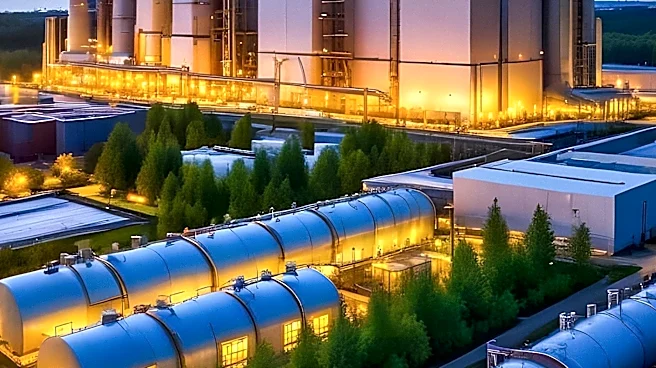
simultaneously boosts crop yields and permanently removes atmospheric carbon dioxide. The funding round was led by Azolla Ventures, with additional support from Counteract VC, Astera Institute, Plug and Play Ventures, Impact Science Ventures, and a Dutch family office. Mafix's method, developed at Stanford University, involves heating a combination of silicate minerals and limestone in cement kilns. This process triggers a solid-state ion exchange, creating more reactive calcium-magnesium silicates that dissolve rapidly when spread on farmland, significantly accelerating weathering and CO2 removal. The company plans to use the capital to produce 1,000 tons of its product for trials across the U.S.
Why It's Important?
Mafix's technology holds significant importance for both the agricultural and environmental sectors in the U.S. By offering a product that acts as both a fertilizer and a carbon removal solution, it addresses two critical challenges: food security and climate change. The ability to accelerate CO2 removal through enhanced rock weathering, while also improving soil quality and potentially reducing conventional fertilizer costs, presents a dual benefit. This innovation could lead to more sustainable farming practices, reducing the carbon footprint of agriculture and offering a new revenue stream for farmers through carbon removal credits. For the U.S. agricultural industry, this could mean increased crop resilience, improved nutrient use efficiency, and a pathway to achieving climate goals. The technology's potential to simplify measurement, reporting, and verification (MRV) for carbon removal also makes it an attractive option for carbon markets.
What's Next?
With the new funding, Mafix plans to produce approximately 1,000 tons of its climate-smart fertilizer for trials across the U.S. over the next year. These larger-scale agricultural trials will be crucial for validating the product's agronomic benefits, such as improved crop yields and nutrient availability. The company aims to generate revenue initially from carbon markets, where enhanced rock weathering credits currently fetch between $200-$500 per ton. Longer-term, Mafix intends for the agricultural product to become economically viable on its own, potentially by incorporating it into conventional fertilizer blends. Mafix also plans to partner with cement producers to utilize underutilized kiln capacity, establishing a distributed logistics network for processing silicate rocks and limestone. Further research and development will focus on demonstrating the product's full potential in reducing demand for conventional NPK fertilizers and enhancing plant resilience.
Beyond the Headlines
Mafix's approach to enhanced rock weathering represents a fascinating intersection of geology, chemistry, and agricultural science. By intentionally modifying silicate minerals to increase their reactivity, the company is essentially engineering a natural process to achieve climate and agricultural benefits more efficiently. The use of existing cement kiln infrastructure for processing highlights a creative solution for scaling up carbon removal technologies, potentially turning an industrial byproduct into a climate solution. This also raises broader questions about industrial symbiosis and how different sectors can collaborate to address environmental challenges. The dual benefit of carbon removal and improved soil health positions Mafix's product as a holistic solution, moving beyond single-purpose climate interventions and offering a more integrated approach to sustainable land management. The success of this technology could inspire further innovations in geoengineering and regenerative agriculture.