




What's Happening?
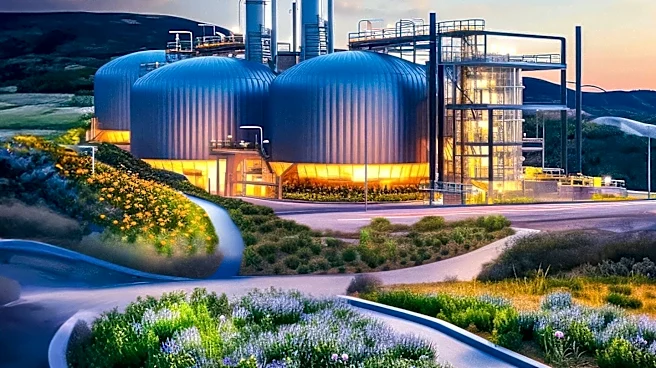
Molten Industries has commenced operations at its new demonstration plant in Oakland, California, focused on producing battery-grade graphite from natural gas. This facility aims to reduce the United States' reliance on foreign sources for this critical
material, as 96% of the global supply of battery-grade graphite is currently processed in China. The plant utilizes Molten Industries' proprietary methane pyrolysis technology, which splits methane into elemental carbon and hydrogen without combustion or oxygen, resulting in zero process emissions. The facility is designed to produce 300 metric tonnes of graphite anode material annually, with a reported conversion yield of over 95% from natural gas to graphite. A significant byproduct of this process is hydrogen, which has various industrial applications, including in the production of ammonia fertilizer, refined petroleum products, and steel.
Why It's Important?
The launch of Molten Industries' plant is a significant step towards establishing a domestic supply chain for battery-grade graphite, a crucial component in lithium-ion batteries used in electric vehicles, data centers, and grid storage. The current heavy reliance on imports, particularly from China, poses economic and national security vulnerabilities for the U.S. By developing a domestic source, the U.S. can enhance its energy independence and bolster its manufacturing capabilities in key strategic sectors. Furthermore, Molten Industries claims its production method is more cost-effective and energy-efficient than traditional synthetic graphite processes, using feedstock that is four times less expensive and requiring three times less electricity. This could lead to more competitive pricing for battery components and accelerate the adoption of electric vehicles and renewable energy storage solutions.
What's Next?
The Oakland demonstration plant, utilizing a modular reactor, is intended to serve as a foundation for potential future, larger-scale facilities. Molten Industries views this commissioning as a critical step towards scaling its technology and building a robust domestic supply chain for essential minerals and chemicals. The success of this demonstration plant could attract further investment and partnerships, potentially leading to the construction of more production facilities across the U.S. This expansion would further reduce import dependency and create new jobs in the advanced manufacturing sector. The company's ability to produce hydrogen as a byproduct also opens avenues for integration into the growing hydrogen economy, offering additional economic and environmental benefits.
Beyond the Headlines
This development has broader implications for U.S. industrial policy and environmental sustainability. By producing battery-grade graphite from natural gas without combustion, Molten Industries' technology offers a potentially cleaner alternative to traditional methods, which often have significant carbon footprints. The generation of hydrogen as a byproduct also aligns with efforts to decarbonize various industrial sectors by providing a clean fuel source. This innovation could contribute to a more circular economy, where waste products are minimized and valuable resources are created. Furthermore, the establishment of domestic critical mineral processing capabilities could reduce geopolitical risks associated with global supply chain disruptions, fostering greater resilience in the U.S. economy and its strategic industries.