






What's Happening?
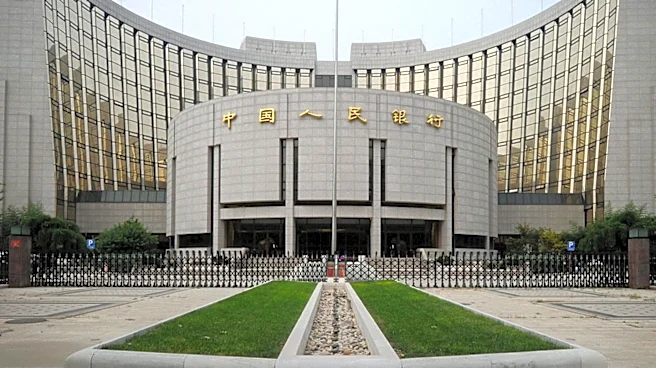
A significant shift is occurring in the global gold market as major Chinese banks, including the Industrial and Commercial Bank of China, Postal Savings Bank of China, Ping An Bank, and China Guangfa Bank, have announced their exit from offering individual
trading in precious metals linked to the Shanghai Gold Exchange. This move, effective from July 24, 2026, marks a coordinated effort by these banks to withdraw from paper gold trading. Concurrently, Hong Kong has launched a new gold clearing and settlement infrastructure aimed at providing an Asian institutional framework for gold transactions outside the London Bullion Market Association (LBMA) system. This development is seen as a strategic repositioning of the gold market, emphasizing physical gold transactions over paper contracts, which are often settled without the actual exchange of bullion.
Why It's Important?
The exit of Chinese banks from paper gold trading is significant as it challenges the traditional dominance of Western markets, particularly the LBMA and COMEX, in setting global gold prices. The shift towards a physical-market-based pricing system could lead to more accurate reflections of supply and demand dynamics, potentially increasing the influence of Asian markets in global gold pricing. This move could also impact retail investors and financial institutions by reducing exposure to the volatility associated with leveraged paper products. Furthermore, the establishment of a new gold clearing infrastructure in Hong Kong suggests a strategic effort to enhance the credibility and trust in Asian gold pricing mechanisms, potentially leading to a more balanced global gold market.
What's Next?
The coordinated exit of Chinese banks from paper gold trading and the establishment of new infrastructure in Hong Kong could lead to a gradual transition where Asian markets play a more significant role in setting gold prices. This may result in a dual benchmark system where Asian physical prices and Western paper prices coexist, creating arbitrage opportunities. The shift could also prompt multinational producers and investors to adjust their strategies, potentially altering project economics and hedging practices. As the influence of Asian markets grows, the global gold pricing architecture may continue to evolve, with potential implications for central banks, investors, and the broader financial system.
Beyond the Headlines
The shift towards a physically-anchored gold pricing regime could have long-term implications for the global financial system. By reducing reliance on paper markets, the move may lead to a more stable and transparent pricing mechanism, potentially reducing market manipulation and speculative volatility. This could enhance the credibility of gold as a financial asset and store of value, attracting more institutional and retail investors. Additionally, the increased influence of Asian markets in gold pricing could reflect broader geopolitical shifts, as China and other Asian economies continue to assert their economic power on the global stage.