

What's Happening?
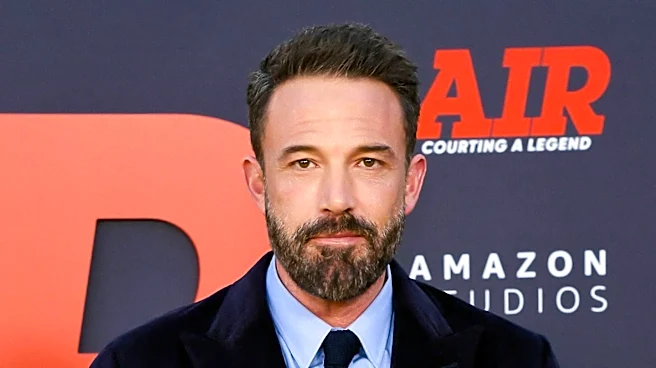
Bill Maher has disclosed that actor Ben Affleck has consistently declined invitations to appear on his show, 'Real Time,' since their heated on-air debate about Islam in 2014. Maher, speaking on the 'Club Random' podcast, stated that despite his annual
invitations, Affleck has not returned. The 2014 exchange became a significant cultural talking point, with Maher and guest Sam Harris making controversial statements about Islam, which Affleck vehemently opposed, calling their views 'gross and racist.' Affleck argued against stereotyping an entire group of people based on the actions of a few, emphasizing that many Muslims are not fanatical. The debate centered on Maher's assertion that Islam is 'the only religion that acts like the Mafia' and Harris's claim that 'Islam is the motherload of bad ideas.'
Why It's Important?
This ongoing refusal highlights the lasting impact of public disagreements, particularly when they involve sensitive topics like religion and cultural identity, and prominent public figures. The incident underscores the challenges of navigating free speech versus accusations of bigotry in media. For the entertainment industry, it demonstrates how personal and political stances can influence professional relationships and public appearances. The debate itself, and its continued reverberations, reflect broader societal tensions regarding religious criticism and cultural understanding in the U.S. It also illustrates the power of televised discussions to shape public perception and create enduring rifts between individuals, even years after the initial event. The public's continued recall of this specific episode, as noted by Maher, signifies its resonance and the deep divisions it touched upon.
What's Next?
It is unlikely that Ben Affleck will appear on 'Real Time' in the near future, given Maher's comments about their unresolved disagreement. The incident will likely remain a notable example of a contentious on-air debate in American television history. For Maher, the episode continues to be a reference point for his show's capacity to generate strong reactions and discussions. For Affleck, his stance reinforces his public image as someone willing to challenge what he perceives as prejudiced views. The broader conversation around the portrayal of religion and cultural groups in media is expected to continue, with public figures often finding themselves at the center of such debates. Future interactions between the two, if any, would likely be scrutinized for any shift in their long-standing disagreement.
Beyond the Headlines
The enduring nature of this disagreement between Maher and Affleck points to deeper societal fault lines concerning religious freedom, freedom of speech, and the rise of identity politics. The debate touched upon the complexities of criticizing religious ideologies without demonizing entire communities, a challenge that continues to be a flashpoint in public discourse. The incident also highlights the role of celebrity platforms in shaping public opinion on controversial issues. Affleck's 'Sesame Street argument'—that one should not judge an entire group based on a few—reflects a common plea for nuance and against generalization, a principle often invoked in discussions about social justice and intergroup relations. The fact that this 2014 debate remains a significant cultural reference underscores the difficulty of achieving consensus or even respectful disagreement on such deeply held beliefs.