






What's Happening?
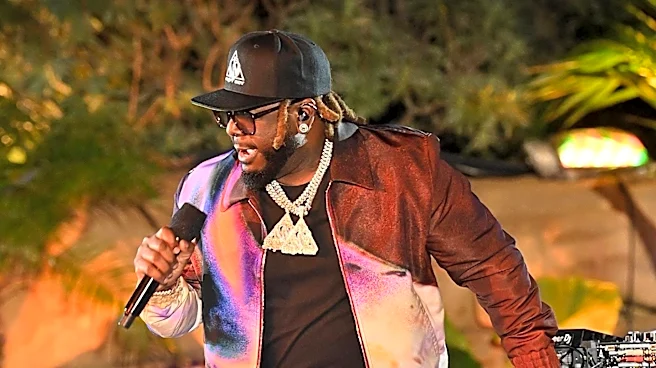
T-Pain has initiated legal action against his former record label, Konvict Muzik, founded by Akon, alleging that he has not received the full amount of royalties owed to him. This lawsuit marks the second time T-Pain has sued Konvict Muzik. The current
claim centers on a $1.3 million royalty payment made to Konvict from a distributor earlier this year, from which T-Pain states he only received half. He is seeking $489,047 in unpaid royalties. T-Pain gained prominence after signing with Konvict Muzik in the mid-2000s, releasing hit songs such as “I'm Sprung,” “I'm 'n Luv (Wit a Stripper),” and “Buy U a Drank (Shawty Snappin').” The previous lawsuit in 2018 concerned an unpaid advance for his album 'Oblivion,' which was settled last year. T-Pain now alleges that the terms of that settlement have been violated.
Why It's Important?
This lawsuit highlights ongoing issues within the music industry regarding artist compensation and royalty payments, particularly for established artists who have generated significant revenue for their labels. The dispute underscores the complexities and potential pitfalls of recording contracts, even for successful musicians. For artists, it emphasizes the critical need for meticulous financial oversight and legal representation to ensure they receive their rightful earnings. For record labels, such legal battles can damage reputations and potentially lead to increased scrutiny of their accounting practices. The outcome of this case could influence how future royalty agreements are structured and enforced, potentially setting precedents for other artists facing similar challenges in recouping their earnings from past works. It also brings to light the long-term financial implications of contracts signed early in an artist's career.
What's Next?
The legal proceedings will likely involve a detailed examination of financial records and contractual agreements between T-Pain and Konvict Muzik. Both parties will present their arguments regarding the alleged unpaid royalties and the terms of the previous settlement. The court will need to determine if Konvict Muzik indeed violated the terms of their agreement and if T-Pain is owed the claimed amount. This could lead to a protracted legal battle, potentially resulting in a court-ordered payment, a new settlement agreement, or a dismissal of the case. The outcome may also prompt other artists to review their own royalty statements and contractual obligations, potentially leading to a wave of similar disputes within the industry. Akon's history of facing similar disputes could also be a factor in the court's considerations.
Beyond the Headlines
Beyond the immediate financial dispute, this case touches upon the broader power dynamics between artists and record labels. It raises questions about transparency in royalty accounting and the mechanisms in place to protect artists' financial interests. The longevity of such disputes, spanning years and even decades after an artist's initial success, reveals systemic challenges in the music business model. This situation could encourage greater advocacy for artists' rights and potentially lead to reforms in standard recording contracts, pushing for more equitable distribution of revenue. It also serves as a cautionary tale for emerging artists to thoroughly understand and negotiate their contracts, particularly concerning long-term royalty structures and dispute resolution mechanisms, to avoid similar issues in the future.